Greyhound Tote Betting UK: Pool Bets, Jackpots & Placepots
Best Greyhound Betting Sites – Bet on Greyhounds in 2026
Loading...
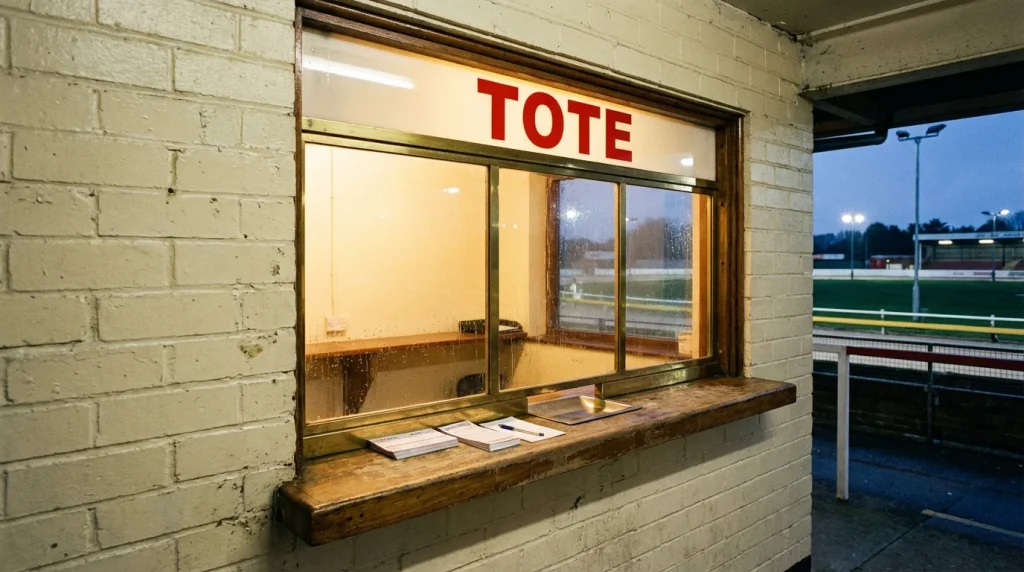
The Tote Doesn’t Set Odds — The Crowd Does
Tote betting operates on a completely different principle from fixed-odds bookmaking. When you place a tote bet, your money goes into a pool shared with every other bettor on the same outcome. The pool is divided among the winners after the operator takes a deduction for running costs and profit. The more people who back the winning dog, the smaller your share. The fewer people who backed it, the bigger your payout. The tote doesn’t decide the odds — the collective action of the betting public does.
Pool betting on greyhounds has a long history in the UK, predating the legalisation of off-course bookmaking by decades. The tote was the first formalised on-course betting system at greyhound tracks, and it remains available at stadiums that still race. It’s also available online through the UK Tote and selected bookmaker platforms, though its share of overall greyhound betting turnover has shrunk considerably as fixed-odds and exchange betting have grown.
For bettors, the tote offers specific advantages in specific situations — particularly in exotic bet types like the Jackpot and Placepot, where the pool structure can produce payouts that fixed-odds markets can’t match.
How Tote Pools Work
Every tote bet contributes to a pool. The pool accumulates all the money staked on a particular bet type for a given race. After the result, the operator deducts a percentage — the “take-out” — which funds the operating costs, regulatory levies, and profit margin. The remaining pool is divided equally among all winning units.
The take-out percentage varies by bet type and operator but typically ranges between 15% and 30% on UK greyhound pools. This is higher than the effective margin on most fixed-odds bookmaker bets and significantly higher than the exchange commission, which means the tote is, on average, more expensive for the bettor per pound staked. The compensating factor is that tote dividends on longshots can substantially exceed fixed-odds payouts because the pool doesn’t cap the return the way a bookmaker’s liability management does.
The win pool is the simplest: pick the winner. Your return depends on how much money was staked on the winning dog relative to the total pool. If the total win pool is £10,000 and £1,000 was staked on the winner, each £1 winning unit receives approximately £10 (before take-out deduction). If only £200 was staked on the winner, each unit receives approximately £50. This is why tote dividends on outsiders can be spectacularly large — when a lightly-backed dog wins, the pool is shared among very few successful bettors.
The place pool works similarly but pays out on dogs finishing in the first two (standard for six-runner fields). The pool is divided among those who selected either of the placed dogs, with each placed dog receiving an equal share of the pool. Place pool dividends tend to be smaller than win pool dividends because more bettors are successful, but they provide a steadier return.
Because tote dividends aren’t known until after the race — the final pool size and distribution determine the payout — there’s inherent uncertainty in tote betting that doesn’t exist with fixed odds. You don’t know what you’ll win when you place the bet. This uncertainty is the trade-off for the potential of outsized returns when your selection goes against the crowd.
Jackpot, Placepot, Exacta
The exotic tote bets are where pool betting on greyhounds becomes genuinely distinctive. These bet types link multiple races together, requiring successful selections across a series of events, and the compound difficulty produces pool dividends that can be substantial from small stakes.
The Jackpot typically requires selecting the winner of six consecutive races at a meeting. Getting all six right from small fields of six dogs is difficult but not impossibly so — the probability is considerably better than a lottery, and skilled form analysis can improve your chances above random selection. Jackpot pools accumulate across meetings, and when the pool rolls over (because nobody correctly selected all six winners), the next meeting’s Jackpot can grow to attractive levels. The rolled-over pool is free money in the sense that it was staked by previous bettors and is now available as additional prize money.
The Placepot is a more accessible variant: select a dog to place (finish first or second) in each of six nominated races. Because placing is easier than winning, the Placepot is hit more frequently, and the dividends are consequently smaller than Jackpot dividends. But the Placepot’s lower volatility makes it a more regular payout opportunity, and on nights where the favourites underperform, the Placepot can produce surprising returns as the pool is shared among fewer successful bettors.
The Exacta (or Forecast Pool) requires selecting the first and second in a single race in the correct order. It’s the tote equivalent of a straight forecast, and the pool structure means the Exacta dividend can differ substantially from the Computer Straight Forecast that fixed-odds bets use. When a popular dog finishes second rather than first, the Exacta pool might contain fewer winning units than the CSF would imply, producing a higher payout.
For bettors, the exotic tote bets offer the best reason to engage with pool betting on greyhounds. The win and place pools rarely offer better returns than fixed-odds bookmakers, but the Jackpot, Placepot, and Exacta operate in a space where the pool structure — particularly when pools have rolled over or when public money is heavily concentrated on favourites — can produce genuine value that the fixed-odds market doesn’t replicate.
Tote vs Fixed Odds
The choice between tote and fixed-odds betting on greyhounds isn’t binary — each has its strengths, and the smart approach is to use both where appropriate.
Fixed-odds betting gives you certainty. You know your return before the race starts. If you’ve identified value at 5/1 with a bookmaker, that price is locked in, and the payout is guaranteed regardless of what other bettors do. This certainty is the primary advantage of fixed odds, and for standard win and each way bets on greyhound racing, the fixed-odds market is almost always the better option because the bookmaker’s margin is typically lower than the tote’s take-out.
Tote betting gives you the possibility of outsized returns at the cost of payout uncertainty. When your selection goes against the majority of the betting public — an outsider wins, a favourite fails — the tote dividend can substantially exceed the fixed-odds equivalent because the pool rewards contrarian selections more generously. This makes the tote particularly attractive for bettors who specialise in backing longer-priced dogs or who have form opinions that diverge sharply from the market consensus.
The take-out differential is important to quantify. If the tote takes 20% from a win pool and the bookmaker’s effective margin is 12%, you’re paying an 8% premium to use the tote on every bet. Over hundreds of bets, that premium erodes returns meaningfully. The tote only compensates for this higher cost when the dividend on your winning selections exceeds the fixed-odds payout by more than the take-out difference — which happens on outsiders but rarely on favourites or mid-priced dogs.
The practical recommendation: use fixed odds for standard bets on dogs priced up to about 5/1, where the bookmaker price is almost always competitive with or better than the tote. Use the tote for exotic bets — Jackpot, Placepot, Exacta — where the pool structure offers something the fixed-odds market doesn’t. And check the tote dividend for outsiders, where the pool can occasionally outpay fixed odds by a significant margin.
Pool Thinking
Tote betting requires a different mental model from fixed-odds wagering. With a bookmaker, you’re assessing whether the price represents value relative to the dog’s actual chance. With the tote, you’re assessing whether your selection will be popular or unpopular with the rest of the pool. The best tote bets are the ones where your form analysis leads you to a selection that the majority of pool bettors have ignored — because the fewer people who share your winning selection, the larger your share of the pool. In tote betting, being right matters. Being unpopularly right matters more.