Greyhound Betting Guide
UK Dog Racing Fast Results: The Complete Guide to Greyhound Betting, Form and Strategy
 Available in US
Fast results, form analysis and betting strategy for every UK track. From racecard to results line, everything you need to bet smarter on the dogs.
The 30-Second Edge: Why Fast Results Change How You Bet on Greyhounds
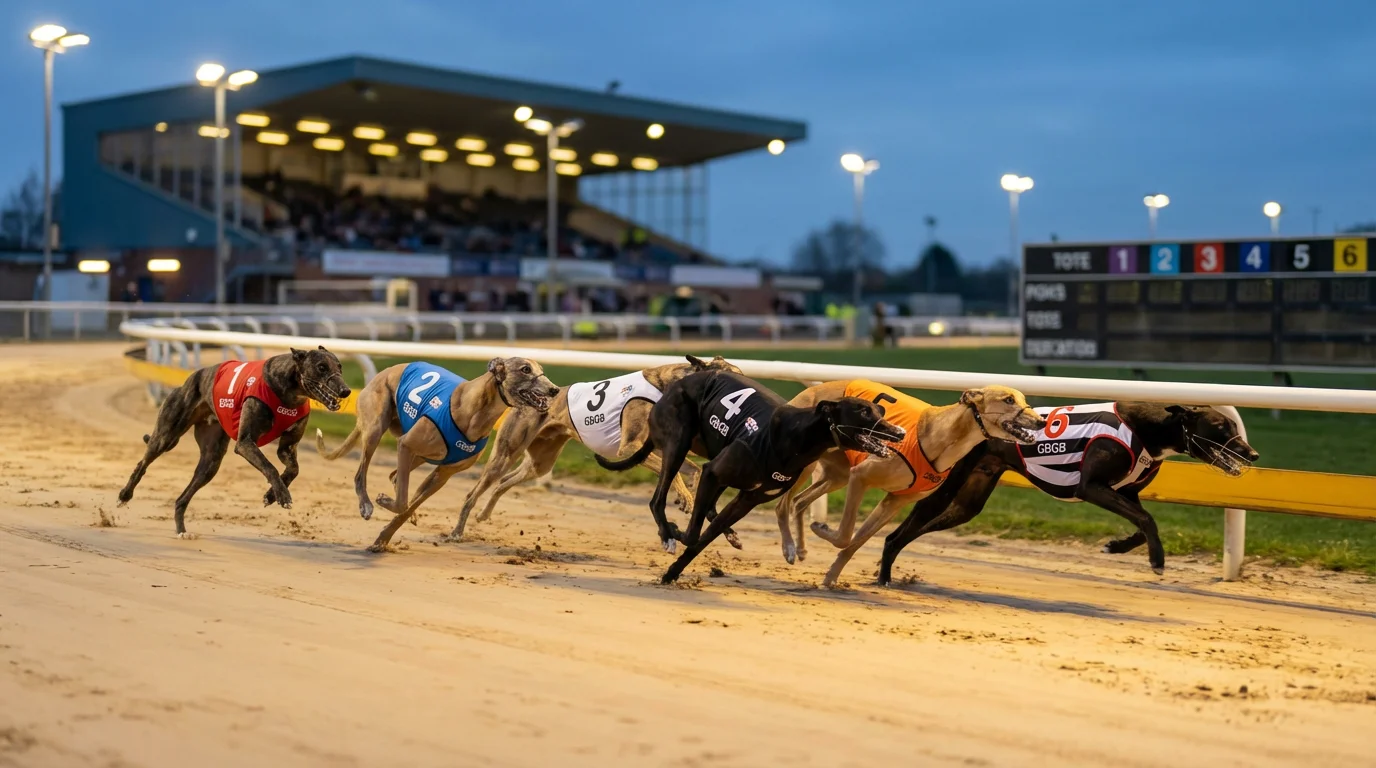
Sixty races. Four hours. Six dogs per trap. On any given evening across Britain's licensed greyhound tracks, the results scroll in faster than most punters can process them. By the time you've checked the form on the 7:42 at Romford, three more races have already gone off at Monmore, Crayford, and Sunderland. This isn't horse racing, where you get a comfortable half-hour between each contest to sip your pint and study the Racing Post. Greyhound racing operates at a tempo that punishes hesitation and rewards preparation.
Fast results matter because they aren't just a record of what happened. They're the raw material for what happens next. Every result line carries data — finishing positions, starting prices, run times, sectional splits, distances beaten, race comments — and the punters who profit from greyhound racing are the ones who know how to read that data and act on it before the next race loads. The gap between casual and sharp isn't talent. It's speed of interpretation.
This guide exists to bridge that gap. Whether you're new to the dogs or you've been betting on greyhounds for years without ever properly reading a racecard, every section that follows is built around one principle: results are only useful if you know what to do with them. We'll cover how UK greyhound racing works at a structural level, how to decode result lines and racecards, which betting markets suit which situations, how trap bias and track data shape selections, and what a genuine betting strategy looks like when you strip away the tipster noise.
Fast Fact
More than 60 greyhound races take place every evening across GBGB-licensed tracks in England, with additional daytime BAGS meetings running from late morning. That volume creates opportunities — but only for those who can process results quickly and systematically.
The sport is celebrating its centenary in 2026, a hundred years since the first mechanical-hare race at Belle Vue in Manchester on 24 July 1926 drew 1,700 spectators. A century later, the audience has moved from the terraces to the screens, and the betting has shifted from on-course bookmakers to mobile apps and exchanges. What hasn't changed is the fundamental proposition: six dogs, one trap each, and a decision to make before the hare moves.
How UK Greyhound Racing Works: The Mechanics That Matter
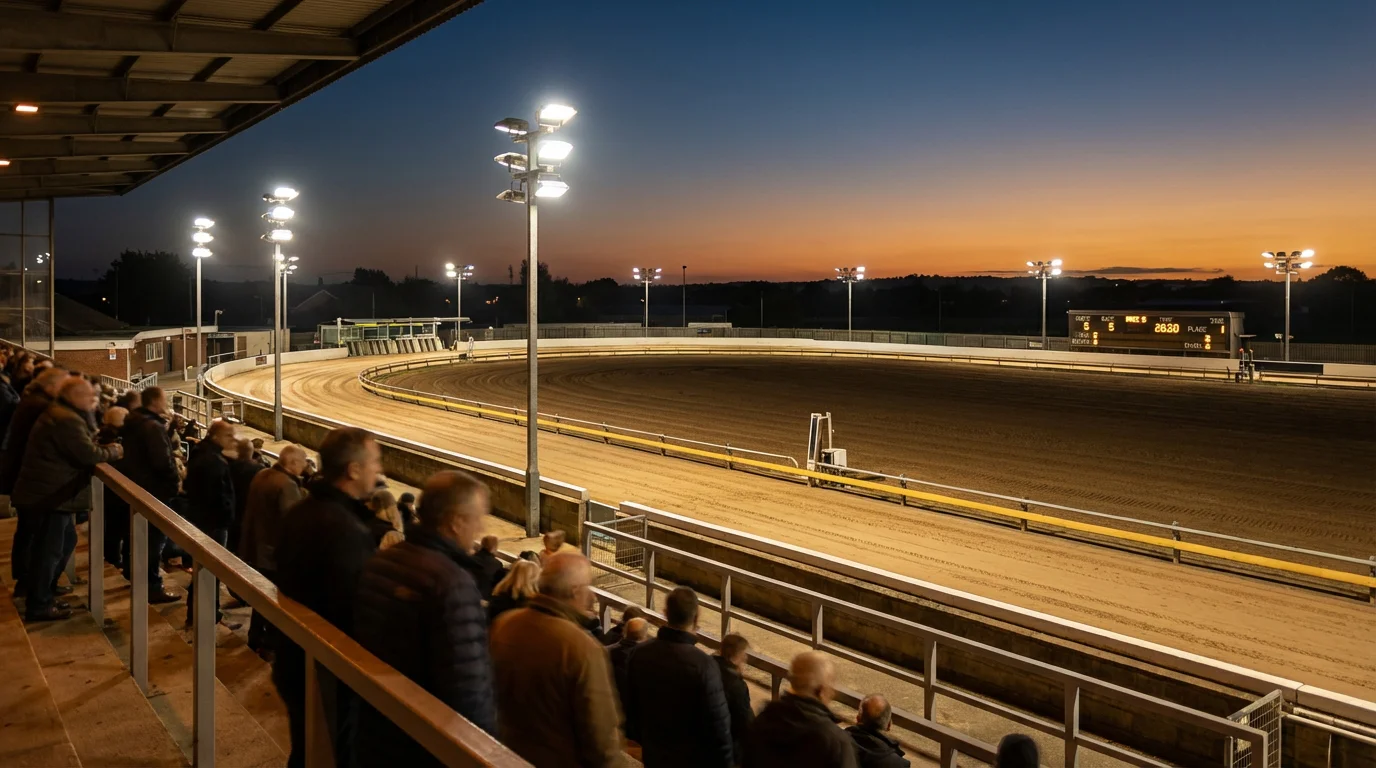
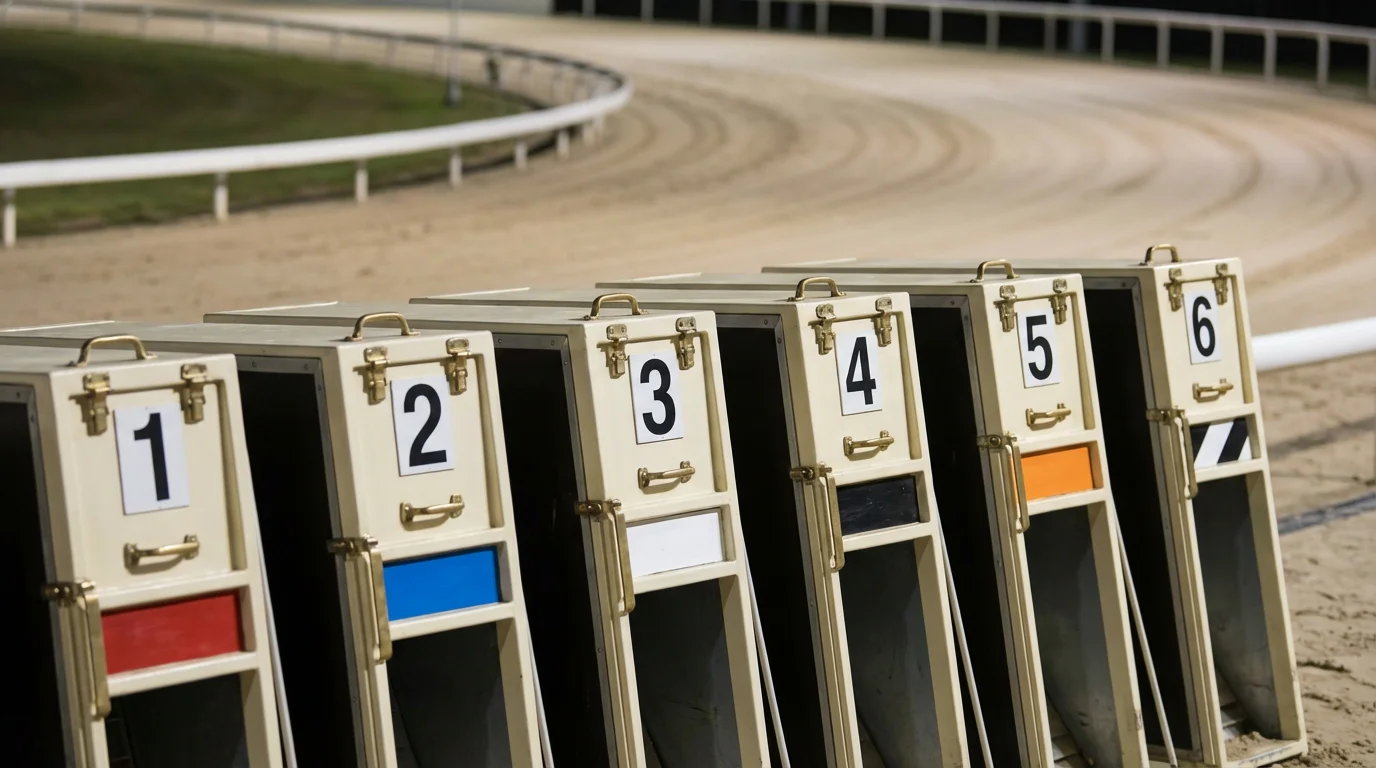
Strip the spectacle away and the sport runs on a simple loop. Six greyhounds are loaded into numbered traps — one through six, each wearing a colour-coded jacket — and released to chase a mechanical hare around a sand track. The race is over in roughly thirty seconds for a sprint, forty-five for a middle-distance event. There's no jockey, no tactical riding, no mid-race instructions. Once the traps open, the dog either runs its race or it doesn't.
All licensed greyhound racing in Great Britain falls under the authority of the Greyhound Board of Great Britain, which regulates 18 active stadia across England and Wales, including one in Wales. The GBGB sets the Rules of Racing, oversees welfare standards, manages the grading system, and conducts drug testing. If you're betting on results from a GBGB track, you're betting on a regulated product with standardised rules and veterinary oversight. This is worth noting because independent or "flapping" tracks — which operated outside GBGB regulation — no longer exist in England following the closure of the last one in March 2025.
UK greyhound racing differs from its American and Australian counterparts in several respects. British tracks are exclusively sand-surfaced, as are modern US tracks. Fields are fixed at six runners, compared to eight in the US and Australia. The grading system, the distance categories, and the trap colours are all specific to the GBGB framework. Irish racing, governed by Greyhound Racing Ireland, runs eight-dog fields and uses a different grading structure entirely. When you're reading results or studying form, knowing which jurisdiction produced them matters — a Trap 1 win at Shelbourne Park is not the same data point as a Trap 1 win at Romford.
Graded racing — the standard competitive structure at GBGB tracks, where greyhounds are assigned a grade (A1 through A11) based on recent performance, ensuring they race against dogs of similar ability.
Graded Racing vs Open Racing
Grade tells you who belongs here. Every greyhound racing at a GBGB track is assigned a grade by the racing manager, typically based on its recent finishing times over a specific distance at that track. The scale runs from A1 at the top — the fastest dogs — down to A11 for those at the lower end. A dog that wins or runs well gets promoted; one that struggles gets demoted. The system exists to create competitive fields where every runner has a realistic chance, which in turn produces closer races and fairer betting markets.
Open races sit above the grading ladder entirely. These are invitation or qualification-based events where the best dogs compete regardless of their grade — feature events, competition rounds, and the big-money finals like the English Greyhound Derby. Open races attract the highest-quality fields and the most betting interest, but they also demand a different analytical approach. In a graded A5 race, you can reasonably compare recent times at the same track and distance. In an open race, you might be comparing a dog from Romford against one from Towcester, running at a distance neither has raced over before. The data doesn't translate as cleanly, and that's where the market tends to overprice familiar names.
Race Distances Across UK Tracks
Distance is the first filter. Every UK track offers at least two distance categories, and the standard breakdown shapes how you approach both form analysis and betting markets.
Sprint
265-285 metres. Pure speed. Early pace is king. Races last around 16-17 seconds.
Standard
400-480 metres. The bread and butter. Two bends minimum, balance of pace and stamina.
Staying
630 metres and above. Endurance matters. Pace conflicts resolve differently over longer trips.
Sprint races are the most unpredictable for bettors. The short distance amplifies the importance of the trap draw and early pace — a slow breaker from trap 1 on a tight track might never recover over 265 metres, whereas over 480 metres it has time to find its stride. Standard distances produce the largest sample of results because most graded races fall into this range, making form data more reliable for comparison. Staying races are rarer, offered at fewer tracks, and tend to attract specialist dogs — which means the form guide carries more weight because you're often dealing with a smaller, more predictable pool of runners.
Track dimensions also vary. Romford's tight circuit plays very differently to Towcester's sweeping galloping track. A dog that excels over 400 metres at one venue might struggle at the same distance elsewhere, not because of fitness but because of how the bends, the run to the first turn, and the camber of the track suit or hinder its running style. Distance alone is never the full picture — it's distance at a specific track that tells you something useful.
Interactive Tool
England Track Count Check, and Trap 1 vs Trap 6 Direct
Verify the guide's two separately-stated track figures actually add up, and see the direct edge Trap 1 holds over Trap 6.
England Tracks (Derived)
-
-
Total (Eng + Wales)
-
Wales Tracks
-
Guide's Later Figure
-
What this guide states in two separate places without connecting: early on, "18 active stadia across England and Wales... including one in Wales"; later, "England's 17 licensed tracks remain active." The subtraction is never shown — but 18 minus 1 does equal 17, confirming the two statements are consistent.
Trap 1 Edge Over Trap 6
-
-
Trap 1 Midpoint
-
Trap 6 Midpoint
-
Win Ratio
-
What this guide compares only to the baseline, never to each other: "Trap 1 winning approximately 18-20% of all races, while Trap 6 wins around 14-16%." Each range is measured against the 16.7% baseline separately — but never against each other. Using the midpoints, Trap 1 wins 4.0 percentage points more often than Trap 6, a 1.27x edge.
Reading Greyhound Results: What Every Line Tells You
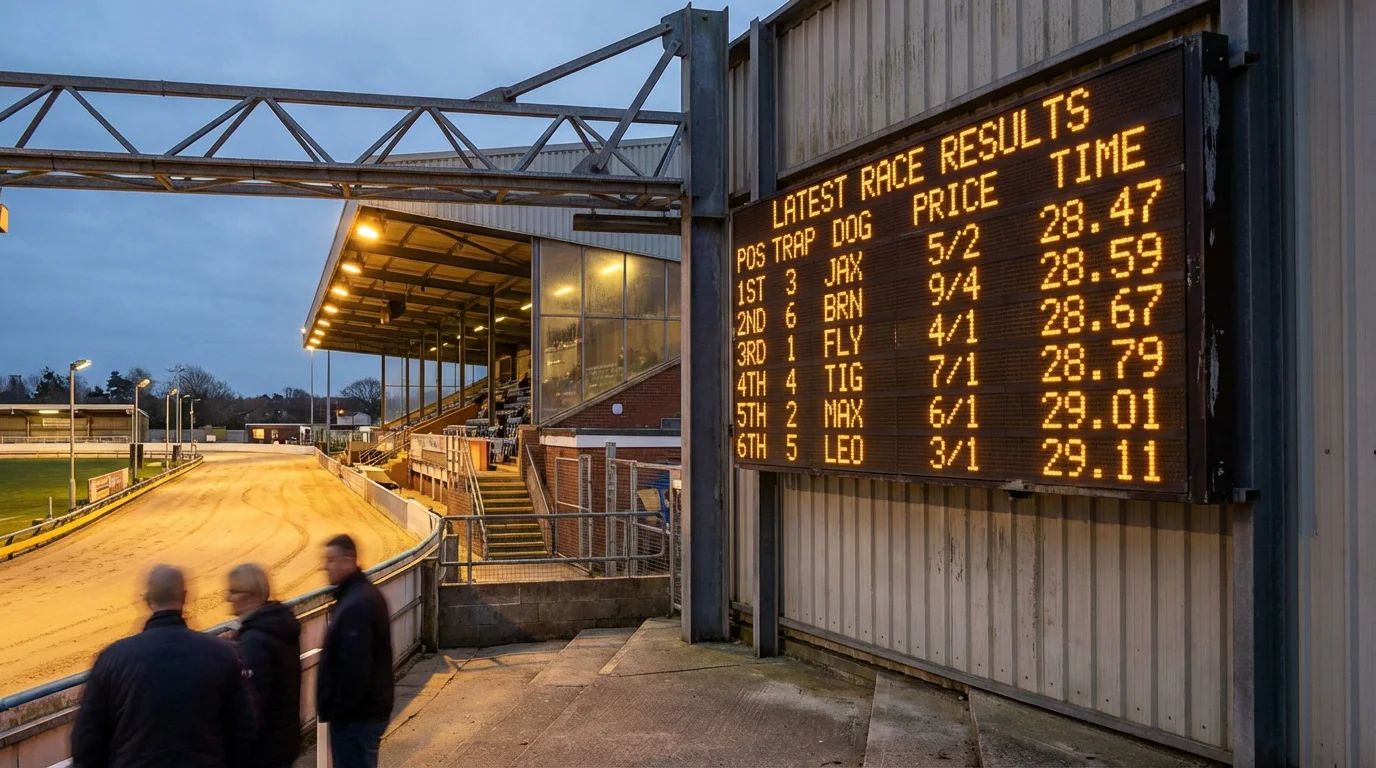
A result line looks like noise until you know where to read. After every greyhound race at a GBGB track, the official result is published in a standardised format. Whether you're pulling it from Sporting Life, Timeform, the Racing Post, or the GBGB's own results page, the core components are the same — though each platform may arrange them slightly differently or add proprietary data like ratings.
Here's what a typical result line contains, and what each element actually tells you.
The finishing position is obvious — first through sixth — but the distances between finishers matter more than the positions themselves. A dog that finishes second, beaten a neck, ran a fundamentally different race to one that finishes second, beaten four lengths. The distance column quantifies this gap, usually in lengths, and it's the difference between "this dog nearly won" and "this dog was never competitive."
The trap number appears alongside the finishing position, indicating which starting box the dog ran from. Cross-referencing the trap number with the result is essential for building track-specific trap bias data. If Trap 1 produces the winner at Monmore three times in one evening, that's not a coincidence — it's the track geometry doing its work.
The starting price reflects the market's assessment of each dog's chances at the moment the race began. SP is the average of on-course bookmaker prices at the off, and it's the benchmark against which you measure whether you got value on your selection. If you backed a dog at 5/1 and it went off at 3/1 SP, you extracted value. If you took 3/1 and it drifted to 5/1, the market was telling you something you missed.
The run time is the dog's actual time from trap to finish line. But actual run time alone can be misleading because it doesn't account for the pace of the hare or the going on that particular night. This is where calculated time enters. Calculated time adjusts the raw run time to a standard, allowing you to compare performances across different nights and conditions. Two dogs might both clock 28.50 seconds over 480 metres, but if one ran on a fast track with a slow hare and the other ran on a heavy track with a fast hare, their calculated times will differ — and the difference reveals which performance was genuinely stronger.
Example Result Line
| Pos | Trap | Dog | SP | Time | Dist | Comment |
|---|---|---|---|---|---|---|
| 1st | 3 | Ballymac Doris | 9/4 | 28.47 | — | Mid,EP,Led2 |
| 2nd | 1 | Droopys Donut | 5/2 | 28.59 | 1 3/4 | Rls,EP,Led1To2 |
| 3rd | 5 | Swift Cobalt | 3/1 | 28.72 | 1 | Wide,SAw,RanOn |
The race comment is the compressed narrative of how each dog ran. "EP" means early pace — the dog broke well. "Led2" means it led from the second bend. "SAw" means slow away. "RanOn" means the dog was finishing strongly, closing ground in the final stretch. These abbreviations look impenetrable at first, but they're the most valuable part of the result line because they explain the how behind the numbers. A dog that finishes third after being badly bumped at the first bend ran a completely different race to a dog that finishes third after leading until the final straight. The comment tells you which scenario applied.
Consistently reading result lines in full — not just the finishing position and the SP — is what separates casual punters from those who build an informational edge. Every line is a compressed race report. The more of them you read, the sharper your form assessments become.
How to Read a Greyhound Racecard Before the Race
The racecard is the menu — you need to read it before you order. Published before every race at every GBGB-licensed track, the racecard contains everything the racing office knows about each runner. Most bettors glance at the trap number, skim the price, and move on. They're ignoring about ninety percent of the available data, and that ninety percent is where the edge lives.
A standard UK greyhound racecard lists six runners, each assigned to a numbered trap. For each dog, the card provides the name, trainer, colour and sex, weight, age, current grade, recent form figures, best and last run times at the track and distance, and a race comment from the most recent outing. Some platforms add predicted times or sectional data, but the core fields are consistent across every GBGB card.
Let's walk through what each of these elements contributes to your assessment.
The dog name and trainer tell you more than you'd think. Trainer form — the recent strike rate of that kennel — is a genuinely useful data point. Some trainers run hot for weeks at a time, placing dogs in the right grades at the right tracks. Others go through cold spells. Tracking trainer form won't single-handedly pick you a winner, but it's a filter that costs nothing to apply and catches patterns that pure form analysis misses.
Weight is listed in kilograms and typically reported to one decimal place. A dog's racing weight fluctuates naturally, but significant changes — more than a kilogram either way — can signal changes in condition. Weight gain sometimes indicates a dog that's being rested and is coming back fresh; weight loss can suggest peak fitness or, less encouragingly, a dog that's been over-raced. The pattern matters more than any single reading.
Grade tells you the level of competition. A dog running in an A3 race is being matched against other A3-grade runners. If you notice a dog that's recently been regraded — dropped from A2 to A4, for instance — that's a significant signal. It might be coming off poor recent form, or it might have been racing out of its depth and is now back at a level where it can compete. The direction of the grade move, and the reason behind it, affects how you weight its chances.
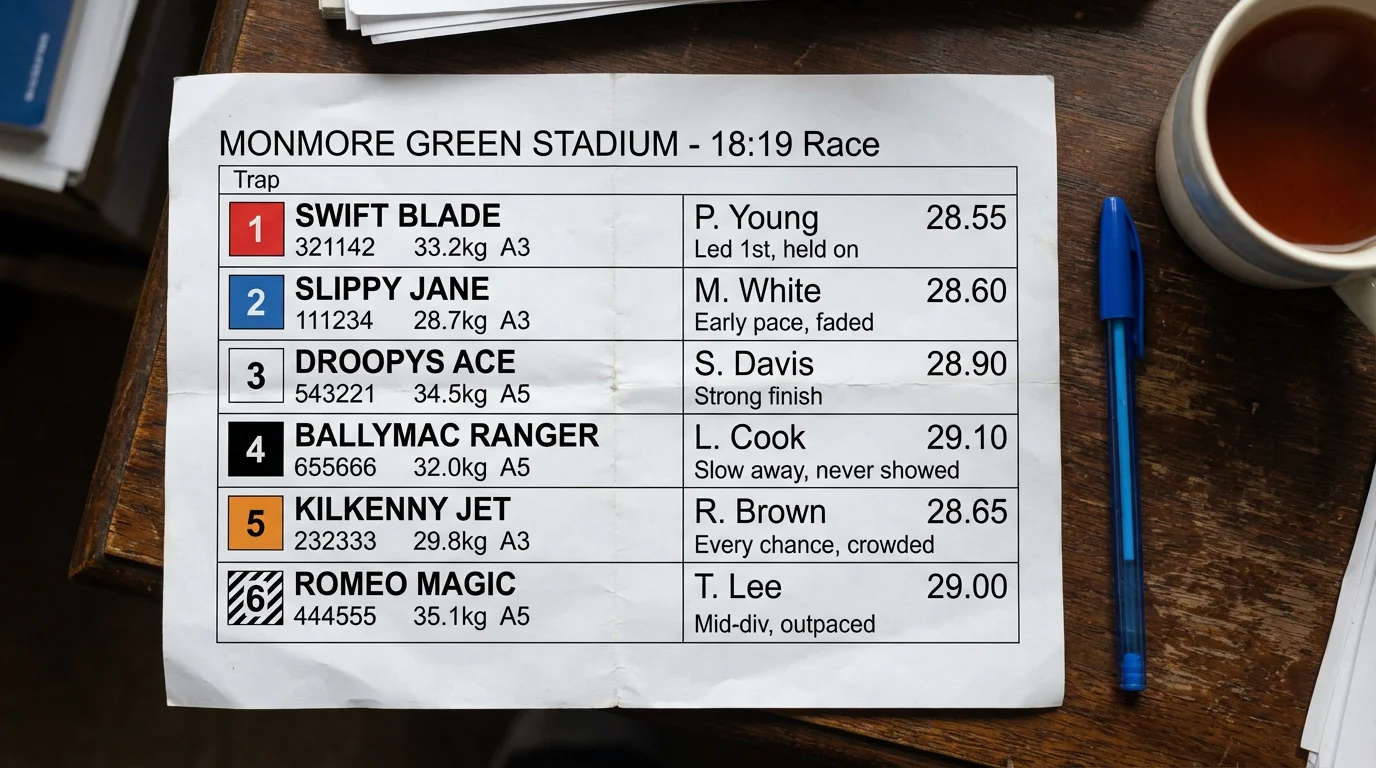
Form Figures
The last six finishing positions, read right to left. A sequence like 321142 tells you: most recently ran second, then first, fourth, first, second, third. Consistency matters as much as wins.
Weight
Listed in kilograms. Track changes over multiple runs — a steady dog is usually a fit dog. Sudden drops or gains are worth investigating.
Grade
Current classification from A1 to A11. Recent regrading is a key signal — dogs dropping grades may find easier competition; those promoted face tougher fields.
Race Comments
Abbreviated race narrative: EP (early pace), SAw (slow away), Crd (crowded), RanOn (finished strongly). These explain how the dog ran, not just where it finished.
Form Figures and What They Actually Signal
Form is biography in shorthand. The six-run form string is the most concentrated piece of information on the racecard, and reading it properly requires more than just counting first-place finishes.
The numbers 1 through 6 represent finishing positions in the dog's most recent races, with the rightmost figure being the most recent run. A zero indicates the dog failed to finish or was disqualified. The letter "m" means the dog was moved to a different trap after the racecard was published — usually because of a non-runner or a late withdrawal. "F" indicates a fall. Each of these carries different analytical weight.
A sequence like 111234 tells a different story to 432111. The first dog is declining — it was winning but has been deteriorating over its last three outings. The second is improving, with three consecutive wins after a slow start. Both might have identical numerical averages, but the trend lines are opposite, and the trend is what matters for your next bet. Always read form left to right for the trajectory, but remember the rightmost figure is the most recent and carries the most relevance to tonight's race.
Bumping codes and race comments must be cross-referenced with the form figures to get the full picture. A "6" looks terrible in isolation, but if the comment reads "Crd&Fell1" — crowded and fell at the first bend — that last-place finish tells you nothing about the dog's ability. Similarly, a "1" achieved by leading from trap to line on a night where the main rival was a non-runner carries less weight than a "1" earned by overtaking the leader on the run-in. The form figure is the headline; the comment is the article. You need both.
Greyhound Betting Markets: Your Options Explained
Six dogs, but the bet options multiply fast. Greyhound racing's compact six-runner fields create a betting ecosystem that's structurally different from horse racing. With fewer runners, the probability of any single dog winning is higher, the fields are more competitive, and the exotic bet types — forecasts, tricasts — become more accessible and more frequently rewarding. Understanding which market suits which situation is at least as important as picking the right dog.
Win betting is where most punters start and where many stay permanently. You pick a dog, it wins, you collect. Simple. The question is whether you take the early price — the odds offered in advance of the race — or accept the starting price, which is determined at the moment the traps open. Early prices give you certainty: if the odds shorten, you've got value; if they drift, you haven't. SP removes the timing decision but exposes you to market fluctuations you can't control. Neither approach is inherently better. The correct choice depends on whether you believe the early price represents genuine value or whether you expect the market to move in your favour.
Forecast betting asks you to predict the first two finishers. A straight forecast requires you to name them in the correct order; a reverse forecast covers both permutations but counts as two bets, doubling your stake. Computer Straight Forecasts use a mathematical formula rather than a declared dividend, which means the payout reflects the actual SPs of the first two dogs. In practice, CSF dividends in greyhound racing can be remarkably generous when two outsiders fill the first two places — because the formula amplifies the combined improbability. In a six-runner field, forecast betting offers a genuine mathematical edge over win betting for punters who can consistently identify two dogs with a high probability of finishing in the places.
Tricast betting extends the principle to the first three finishers in exact order. The straight tricast is high risk and high reward — getting three dogs in sequence is difficult even in a six-runner field. Combination tricasts cover all six possible permutations of your three selections, costing six times the unit stake. The payouts can be substantial, particularly in races where the first three finishers include at least one outsider. But the maths works both ways: six units staked means you need a healthy dividend to generate a meaningful return.
Exchange betting on platforms like Betfair and Betdaq offers a fundamentally different proposition. Instead of betting against a bookmaker, you're betting against other punters. You can back a dog to win or lay it to lose. Greyhound exchange markets are thinner than their horse racing equivalents — less money is matched, which means the odds can be less efficient but also harder to get on at the price you want. Pre-race trading is possible but requires speed and screen discipline, and in-play betting on a race that lasts thirty seconds is a specialist pursuit that suits very few punters.
Important
The decision between taking an early price and waiting for SP should be made before you assess the racecard, not after. Set your staking rules in advance: if the early price exceeds your estimated fair probability by a defined margin, take it. If not, wait. Emotional price-taking — grabbing odds because they "look good" — is one of the quickest ways to erode your bankroll in a high-frequency sport.
When to Bet Each Way on Greyhounds
Each way is insurance — and like all insurance, you're paying a premium. An each-way bet on a greyhound is two bets: one on the dog to win, one on it to finish first or second. The place part pays at one-quarter of the win odds. So a £5 each-way bet at 8/1 costs £10 total. If the dog wins, you collect both the win and place portions. If it finishes second, you collect the place part only: £5 at 2/1 (a quarter of 8/1), returning £15 including your stake.
The arithmetic reveals when each-way betting actually offers value in a six-runner greyhound race. It works best when a dog has a strong chance of finishing in the first two but isn't the outright favourite. At shorter prices — 2/1 or less — the place return is so small that you're effectively paying double for a marginal safety net. At 8/1 or longer, if the dog genuinely has place credentials, the each-way bet can offer positive expected value even if its win chances are slim. The sweet spot is typically dogs priced between 5/1 and 10/1 that have shown consistent placed form at the track.
The trap for casual punters is treating each-way as a default option. "I like this dog but I'm not sure it'll win, so I'll go each way." That reasoning feels prudent but is often mathematically poor. You're doubling your outlay for a place return that, at short odds, barely covers your stake. Unless the place component carries genuine expected value on its own merits, a straight win bet at half the total each-way stake is often the sharper play.
Trap Draw and Track Bias: The Data That Bookmakers Price In
Trap 1 wins more often than it should. That's not luck — it's geometry. The inside rail gives Trap 1 runners the shortest route to the first bend, and on tight tracks where the run from the boxes to that bend is short, the advantage is measurable and persistent. Across UK tracks as a whole, aggregate data shows Trap 1 winning approximately 18-20% of all races, while Trap 6 wins around 14-16%. In a perfectly fair six-runner field, each trap would win 16.7% of the time. The deviation from that baseline is what punters call trap bias, and it's one of the few genuinely free data points in greyhound racing.
But aggregate figures hide the real story. Track-by-track data reveals dramatic variations. At Monmore Green, the inside traps dominate to a degree that makes the aggregate look mild — Trap 1 regularly outperforms its expected win rate by several percentage points. At Romford, traps 1 and 2 carry a pronounced advantage because of the short run to the first bend and the tight first turn. At Towcester, which has a longer run-up and wider, more sweeping bends, the bias is less pronounced, and middle traps perform comparably to the inside.
How you use this data matters more than knowing it exists. Trap bias should function as a modifier, not a selection method. If you've identified two dogs with similar form in the same race and one is drawn in Trap 1 at a track with known inside bias while the other sits in Trap 5, the draw gives you a tiebreaker. What it doesn't do is turn a poor dog into a good bet. Punters who bet Trap 1 blindly because "it wins most" are confusing a statistical tendency with a strategy. The bookmakers already price trap bias into their odds — particularly at tracks where the pattern is well established — so the edge isn't in the raw data but in identifying races where the draw advantage hasn't been fully accounted for in the market.
Under the GBGB's updated 2026 Rules of Racing, stewards are now required to publish reasons for all pre-race withdrawals, which improves transparency around non-runners and reserve runners. This matters for trap bias because a late withdrawal can shift a dog to a different trap, altering the bias dynamic for that race. Keeping track of these movements — and understanding how a trap reassignment changes the profile of the race — adds another layer to the analysis.
Trap bias alone won't pick winners — but ignoring it means ignoring free data. Use it to adjust assessments, not to replace them.
Greyhound Betting Strategy: From Results to Decisions
Strategy isn't a magic formula. It's a repeatable process. The word "strategy" gets misused in betting circles, usually attached to whatever system some tipster is selling that week. In greyhound racing, a strategy is simply a framework for making decisions that are consistent, justifiable, and — over time — measurable. If you can't explain why you're backing a dog before the traps open, you don't have a strategy. You have a hunch.
Three approaches dominate serious greyhound betting, and the most effective punters usually combine elements of all three rather than committing exclusively to one.
Form-first analysis is the foundation. It means assessing each runner based on its recent performances — typically the last three to six runs — with emphasis on runs at the same track and distance. You're looking for patterns: improving times, consistent early pace, the ability to handle specific trap draws, performance after rest periods. Form analysis done properly accounts for the quality of opposition (the grade of the race, the calibre of the other runners) and the circumstances of each run (was the dog impeded, did it have a clear run, did it lead or come from behind). Raw form figures without context are decorative. Contextualised form is analytical.
Data-driven approaches go deeper. This means working with calculated times rather than raw run times, applying trap bias adjustments for the specific track, factoring in sectional splits where available, and building your own ratings for each runner. You don't need sophisticated software — a spreadsheet that logs each dog's calculated time, adjusts for trap position, and produces a simple ranking is enough to put you ahead of anyone betting on instinct. The barrier isn't complexity. It's consistency. Building and maintaining a personal database of results takes time, but the punters who do it systematically tend to identify value that the market misses.
Market-based strategy focuses on the odds themselves rather than the dogs. Every bookmaker builds a margin into their greyhound prices — the combined implied probabilities of all six runners sum to well above 100%. Your task as a market-based bettor is to estimate the true probability of each runner winning and compare it to the implied probability in the odds. When your assessment says a dog has a 25% chance of winning but the odds imply only 15%, that's a value bet — regardless of whether the dog actually wins that particular race. Over a sufficient sample, backing positive expected value consistently is the only mathematical path to long-term profit.
Do
- Track your bets in a spreadsheet — every selection, every price, every result. You can't improve what you don't measure.
- Specialise by track. Knowing one venue inside out beats surface familiarity with ten.
- Calculate expected value before staking. If the maths doesn't justify the bet, walk away.
Don't
- Chase losses between races. With a new race every fifteen minutes, the temptation to recover quickly is the fastest route to a blown bankroll.
- Follow tips blindly. A tip without a rationale isn't a tip — it's someone else's guess.
- Ignore bankroll management. Without a staking plan, even a genuine edge erodes over time.
The favourite wins approximately 33% of UK graded greyhound races — meaning it loses roughly two-thirds of the time. That's not a flaw in the system. It's the system. If favourites won reliably, there would be no betting market.
Spotting Value in Greyhound Odds
The market is right most of the time. Your job is to find the rest. Value in greyhound racing isn't about finding the winner — it's about finding prices that overestimate the probability of losing. The distinction is subtle but essential.
Start with the overround. If you add up the implied probabilities from the bookmaker's prices for all six dogs, the total will exceed 100% — typically landing between 120% and 130% for greyhound races. That excess is the margin. A race with prices of 2/1, 3/1, 4/1, 5/1, 8/1, and 10/1 converts to implied probabilities of 33.3%, 25%, 20%, 16.7%, 11.1%, and 9.1% — totalling 115.2%. The real probabilities must sum to 100%, so the bookmaker has inflated the implied likelihood of each dog winning. Your job is to figure out where the inflation is greatest.
Tissue prices — the early-morning odds compiled by bookmakers' odds compilers before the market opens — offer a baseline. When the market price for a dog is significantly longer than its tissue price, the market is drifting the dog out, which sometimes reflects genuine information (a bad trial, a kennel concern) and sometimes reflects an overreaction to a single poor run. Conversely, when a dog's price shortens sharply from its tissue, money is coming in — either from informed connections or from the public following tips. Neither movement guarantees anything, but tracking the direction and speed of price changes gives you a layer of information that pure form analysis can't provide.
The discipline of value betting is patience. You'll pass on more races than you bet on. In a sport with 60-plus races per evening, the pressure to have a bet in every race is real but poisonous. The profitable approach is selective: identify the races where your analysis produces a clear discrepancy from the market, bet only those, and accept the long gaps between qualifying selections. It's not exciting. It's effective.
Where to Watch and Bet on UK Greyhound Racing
You don't need to be trackside to have trackside information. The infrastructure that delivers live greyhound racing to screens across Britain has expanded significantly over the past decade, and in 2026 there are more ways to watch, follow, and bet on UK dog racing than at any previous point in the sport's hundred-year history.
SIS (Sports Information Services) is the backbone of live greyhound broadcasting in the UK. SIS supplies the audio-visual feed for the majority of BAGS meetings — the daytime cards funded by bookmakers that run from late morning through the afternoon at tracks like Crayford, Sunderland, Henlow, and Central Park. If you've ever watched a greyhound race in a betting shop, you were almost certainly watching an SIS feed. The same feeds are available via the major online bookmakers, which stream them to desktop and mobile. SIS coverage is functional rather than glamorous — you get the race, the results, and the SP — but it's reliable and immediate.
Sky Sports Racing covers the bigger evening meetings and feature events, including the build-up to major competitions. The channel is available on Sky (channel 415), and selectively through bookmaker streaming services. For the flagship events — the English Greyhound Derby at Towcester, which runs from 30 April to 6 June this year with a winner's purse of £175,000, or the St Leger and TV Trophy — Sky provides pre-race analysis, trackside interviews, and race commentary that adds genuine context to the data. RPGTV, available on Freeview, provides additional coverage of evening meetings.
Bookmaker live streams are the most accessible option for most punters. Bet365, Paddy Power, William Hill, Betfair, and most other major UK bookmakers stream greyhound racing directly through their apps and websites. The catch is usually a qualifying condition: you need a funded account, or to have placed a bet on the race you want to watch. Stream quality varies, and there's typically a delay of a few seconds behind the live action — something to be aware of if you're considering in-play exchange trading, where seconds matter.
Fast results services fill the gap between watching and waiting. Platforms like Sporting Life, Oddschecker, Timeform, and At The Races publish greyhound results within seconds of each race finishing, complete with SPs, finishing positions, distances, and race comments. These aren't just for checking whether your bet won — they're working tools for updating form assessments between races. If you're betting across multiple meetings on a busy Saturday evening, fast results let you adjust your analysis for the next race at Track B based on what just happened at Track A.
BAGS meetings — the daytime racing cards funded by bookmaker contributions — account for the majority of greyhound races run in Britain each week. Most punters associate greyhound racing with evening entertainment, but the real volume happens before 4pm.
Responsible Betting: The Non-Negotiable Section
Bankroll management isn't optional — it's the strategy underneath the strategy. With live streams, fast results, and round-the-clock coverage making it easier than ever to bet on greyhounds, the tools that keep you in the game matter as much as the tools that help you pick winners. This section exists not as a legal disclaimer but as a genuine component of any serious approach to greyhound betting. The speed and volume of dog racing makes it uniquely dangerous for undisciplined staking. With a new race every ten to fifteen minutes across multiple tracks, the temptation to chase a losing run or increase stakes after a win is constant and corrosive.
Set a betting bank before you place your first bet of the evening. Define your maximum stake per race as a percentage of that bank — most professional bettors recommend between 1% and 3%. If your bank is £200, your maximum stake is £2 to £6 per race. This sounds conservative, and it is. That's the point. Conservative staking keeps you in the game long enough for your edge — if you have one — to compound. Aggressive staking ensures that even a genuine edge gets wiped out by variance.
The UK Gambling Commission licenses and regulates all legal betting operators in Britain. Every licensed bookmaker is required to offer self-exclusion tools, deposit limits, loss limits, and reality checks. These aren't there for other people. They're there for anyone who bets, and using them is a sign of discipline, not weakness.
Important
If gambling is causing you financial stress or affecting your wellbeing, support is available. GambleAware offers free, confidential advice at www.gambleaware.org or via their helpline on 0808 8020 133. The National Gambling Helpline operates 24 hours a day, seven days a week. Self-exclusion through GAMSTOP covers all UKGC-licensed online operators in a single registration at www.gamstop.co.uk.
FAQ
How do I read greyhound form figures and what do the racecard symbols mean?
Greyhound form figures are a string of numbers representing the dog's finishing positions in its most recent races, read right to left with the rightmost figure being the latest run. Numbers 1-6 indicate finishing position, "0" means the dog failed to finish or was disqualified, "m" indicates it was moved to a different trap, and "F" means it fell. Race comments use standard abbreviations: EP (early pace), SAw (slow away), Led (led the race), Crd (crowded or impeded), RanOn (finishing strongly), Bmp (bumped), and Wide or Rls (rails) to describe the running line. Always cross-reference the form figures with the race comments, because a sixth-place finish caused by interference at the first bend tells a completely different story to a sixth-place finish in a clear-run race. The best assessments combine finishing positions, race comments, run times, and the grade of the race in which the performance occurred.
Does trap position affect the outcome of a greyhound race?
Yes, but the effect varies significantly between tracks. Across all UK greyhound tracks, Trap 1 wins approximately 18-20% of races compared to the statistically expected 16.7% for any single trap in a six-runner field, while Trap 6 typically wins around 14-16%. However, aggregate figures mask the real variation. At tracks with tight first bends and short run-ups — like Romford and Monmore Green — the inside traps carry a pronounced advantage. At tracks with wider, more sweeping circuits, such as Towcester, the bias is much less pronounced. Trap bias is a useful analytical tool but should be treated as a modifier to your selection process, not the basis of it. Bookmakers already factor known trap bias into their odds, so the value lies in identifying races where the bias effect hasn't been fully priced in.
What percentage of favourites win in UK greyhound racing?
In UK graded greyhound racing, the favourite wins approximately 30-35% of the time. This figure is broadly consistent across tracks and grades, though it can vary slightly depending on the quality of the field. The relatively low strike rate compared to other sports reflects the competitive nature of six-runner fields where the grading system is specifically designed to create close contests. For bettors, this means that backing every favourite would produce a long-term loss because the odds offered on favourites already account for their higher win probability — and the bookmaker's margin ensures the payout is below fair value over time. The favourite's win rate is one of the key reasons that value-based approaches, rather than favourite-backing systems, tend to be more sustainable over large samples.
The Last Trap: Where Results End and Decisions Begin
Results are history by the time you read them. The question is what you do next. Greyhound betting is a volume game played on the margins, and the margins are measured in fractions — of a second, of a length, of a percentage point of expected value. The punters who sustain profitability over months and years aren't the ones who pick the most winners. They're the ones who make the most disciplined decisions, race after race, evening after evening.
The sport itself stands at an interesting juncture. As greyhound racing enters its centenary year, it carries both the momentum of a loyal audience and the weight of shifting public attitudes. The Welsh Senedd is advancing legislation to prohibit greyhound racing in Wales — the Prohibition of Greyhound Racing (Wales) Bill passed its Stage 1 vote on 16 December 2025 and proceeded to Stage 2 committee scrutiny in January 2026, though legal challenges from the GBGB continue. Scotland has signalled similar intentions. England's 17 licensed tracks remain active and well-attended, but the regulatory and political landscape is evolving in ways that will shape the sport for the next decade.
None of that changes the fundamentals of what happens when six dogs leave the traps. The hare moves, the boxes open, and thirty seconds later there's a result. Your edge, if you have one, was built before the traps opened — in the form analysis, the data, the market assessment, the staking discipline. Everything that follows is just confirmation or feedback.
Fast results give you that feedback faster than any other sport. Use them well.
