Greyhound Starting Price SP Explained: How Odds Are Set
Best Greyhound Betting Sites – Bet on Greyhounds in 2026
Loading...
SP Is the Price You Didn’t Choose
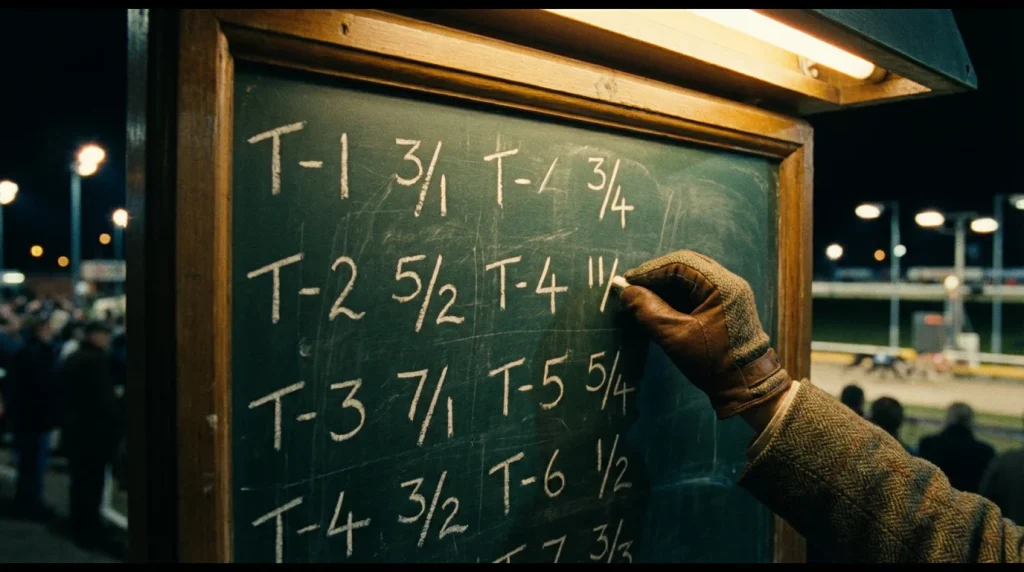
If you didn’t take a price, SP takes one for you. The starting price in greyhound racing is the odds assigned to each dog at the moment the traps open. It’s not a price you negotiate or select — it’s determined by the market at the track, and it applies automatically to any bet placed without a fixed price.
For many casual bettors, SP is the default. They back a dog, don’t lock in a price, and accept whatever the starting price turns out to be. This approach is convenient but passive, and in greyhound racing, where odds can shift substantially in the minutes before a race, passivity has a cost. The difference between taking 5/1 early in the day and settling for 3/1 at SP can be the difference between a profitable afternoon and a flat one.
Understanding how SP is calculated, when it works in your favour, and when you’re better off taking an early price is fundamental to getting the most from greyhound betting. It’s one of those mechanical details that separates bettors who think about process from those who simply pick dogs and hope.
How SP Is Calculated in Greyhound Racing
SP is the average of on-course bookmaker odds at the off. At tracks with on-course bookmakers — which in practice means the evening meetings at major venues — officials record the prices displayed by the bookmakers’ boards at the moment the hare starts running. Those prices are averaged, and the result becomes the official starting price for each dog in the race.
At BAGS meetings and tracks without on-course bookmakers, the SP is determined differently. It’s typically derived from the returns offered by the major online bookmakers at the time of the off, using an industry-standard methodology overseen by the SP regulatory body. The process is designed to produce a fair reflection of the market, but it’s worth noting that SP at a meeting without on-course bookmakers can sometimes behave differently to SP at a busy evening meeting where actual cash is changing hands over the rails.
The mechanics matter because SP is reactive. It reflects where the money has gone, not where the value was earlier in the day. If a dog opens at 6/1 in the morning market and money pours in throughout the day, the SP might be 3/1 or shorter. Punters who backed at 6/1 have a much better position than those who took SP. Conversely, if a fancied dog drifts — its price gets longer as money moves elsewhere — the SP might actually be better than the early price.
In greyhound racing, the on-course bookmaker boards at evening meetings tend to be influenced by both the money arriving at the track and the prices available online. A significant gamble on an online bookmaker will usually filter through to the on-course market, which means the SP reflects a blend of online and trackside activity. The process isn’t perfect, but it’s transparent enough for bettors to understand the dynamics.
One nuance that catches some bettors out: SP in greyhound racing is generally less stable than SP in horse racing. The smaller fields (six runners versus twelve or more in a typical horse race) mean that a relatively modest amount of money can move a dog’s price significantly. A few hundred pounds on a dog at a quiet meeting can compress the odds from 4/1 to 5/2, which materially affects the SP. This volatility is higher in BAGS racing, where market liquidity is thinner.
Early Price vs SP: When to Lock In
Early prices exist for a reason — so does letting them go. Most major bookmakers publish greyhound prices several hours before a meeting begins, sometimes the night before for evening cards. These early prices are the bookmaker’s opening assessment of each race, and they’re based on form analysis, automated models, and a built-in margin. They’re not charity — the bookmaker expects to profit from them — but they do sometimes contain value that disappears by the time SP is determined.
The general principle is straightforward: if you’ve identified a dog you rate as overpriced in the early market, take the price. Waiting for SP risks the market correcting towards the dog’s true probability, which means a shorter price and less value. This is particularly true for dogs that you expect other informed bettors to also back — once the money arrives, the price contracts.
There are exceptions. If a dog has a known issue — a tendency to be slow from the traps, inconsistent early-pace form, or a trainer who has a patchy recent record — the early price might already reflect optimistic assumptions. In that case, waiting to see how the market develops can be sensible. If the price drifts (gets longer), it might indicate that informed money is going elsewhere, which could reinforce your reservations.
Some bettors adopt a hybrid approach: take the early price on selections they’re confident about, and use SP for selections where they’re less certain and want to see how the market moves. This isn’t a scientific method, but it acknowledges the reality that early prices and SP serve different functions. The early price locks in your position. SP lets the market decide for you.
Best Odds Guaranteed — a promotion offered by many UK bookmakers — removes some of the dilemma. With BOG, if you take an early price and the SP turns out to be higher, the bookmaker pays out at the better price. This makes taking early prices considerably less risky, because you capture any upward movement while protecting your floor. Not all bookmakers offer BOG on greyhound racing, and those that do sometimes exclude BAGS meetings, so check the terms before assuming you’re covered.
SP in the Age of Exchanges
Betfair SP offers an alternative. It’s not always better. The Betfair Starting Price is calculated from the exchange market at the moment the race starts, and it operates independently of the traditional on-course SP. Because the exchange market is driven by supply and demand from individual bettors rather than bookmaker boards, BSP can sometimes differ significantly from the industry SP — in either direction.
In greyhound racing, exchange market liquidity is substantially lower than in horse racing. A typical greyhound race on Betfair might have a few thousand pounds matched across all runners, compared to tens or hundreds of thousands on a competitive horse race. This thin liquidity means that BSP can be volatile. A late bet of a few hundred pounds can push the BSP noticeably, and the price you receive might not reflect the broader market consensus.
The advantage of BSP is that the exchange typically operates at a lower margin than traditional bookmakers. Over a large number of bets, the BSP tends to return slightly more to the bettor than the industry SP, assuming comparable prices. The disadvantage is unpredictability: you won’t know your BSP until after the race, and in a thin market, the result can surprise you.
For bettors placing small to medium stakes on greyhound racing, BSP is a reasonable alternative to industry SP, particularly on evening meetings at major tracks where the exchange market is slightly deeper. For larger stakes, or for BAGS racing where exchange liquidity is minimal, the traditional fixed-odds market — with an early price if possible — is usually the more reliable option.
The Price of Timing
Odds are a snapshot. SP is the last one before the race. Every price you see — the morning tissue, the early price, the midday market, the on-course boards — is a frozen moment in a continuously moving market. SP captures the final frame. It’s the market’s closing verdict on each dog’s chance, informed by every piece of money and every piece of information that arrived before the traps opened.
The bettors who think about SP as a strategic element rather than an automatic default are the ones who extract more value from greyhound racing over time. Taking a price when you have an opinion. Letting SP work when you don’t. Understanding that the price you accept is as much a part of the bet as the dog you’ve chosen. In a sport where margins are thin and volume is high, the discipline of timing pays dividends that no tip sheet can match.