Reading Greyhound Form: How to Interpret Race History
Best Greyhound Betting Sites – Bet on Greyhounds in 2026
Loading...
Form Is the Only Evidence That Matters
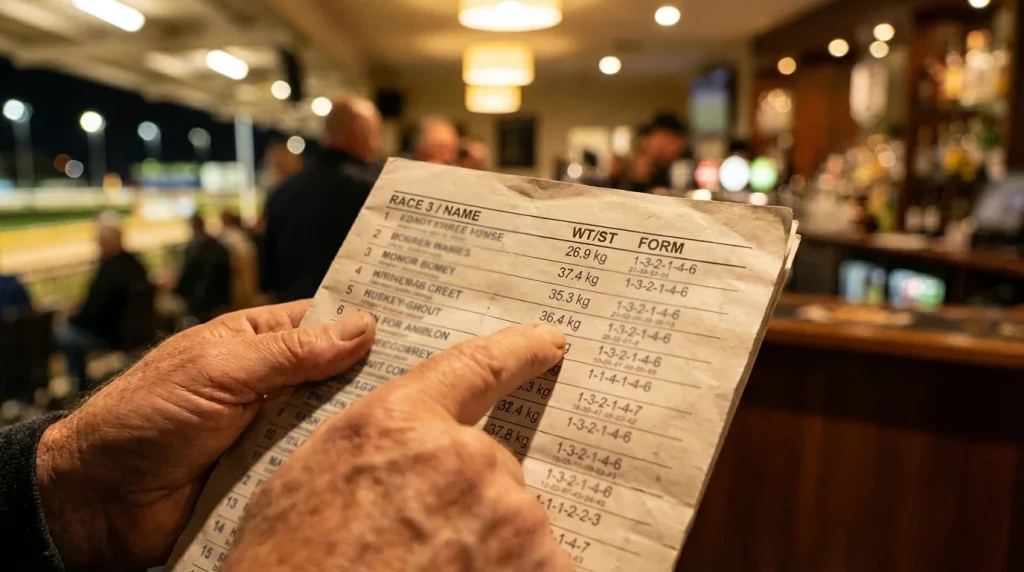
Greyhound racing has no paddock parade where you can judge the animal’s fitness by sight. There are no jockey bookings to signal intent. There’s no warm-up you can watch to assess sharpness. What you have is form — the record of a dog’s recent races, distilled into numbers, abbreviations, and comments that encode everything the dog has done on the track. Reading form fluently is the single most important skill in greyhound betting, and it separates bettors who operate on evidence from those who operate on hope.
Form in greyhound racing is compact by design. A dog’s recent history is compressed into a line of figures and codes that can be scanned in seconds once you understand the system. The challenge isn’t the volume of data — it’s knowing which data points matter most for the specific race you’re assessing, and which can be safely set aside.
What Form Figures Mean
The form line on a greyhound racecard reads from left to right, most recent run first. Each digit represents the dog’s finishing position in a race: 1 for first, 2 for second, through to 6 for last. A typical form line might read 2-1-3-4-1, which tells you the dog finished second last time out, won the time before, ran third, then fourth, then won again. Five runs condensed into five numbers.
Beyond the raw finishing positions, additional codes and symbols carry important information. An “F” indicates a foul or a fall — the dog was involved in significant interference. A “T” or similar code can denote a trial rather than a competitive race. “NR” means the dog was a non-runner for that race. Some form guides include trap numbers alongside each finishing position, which is crucial context because a dog that finished third from trap 6 at a track with inside bias had a harder task than one that finished third from trap 1.
The race comments that accompany each line of form provide qualitative context that the numbers can’t. Comments like “led to bend 3, faded” tell you the dog had pace but couldn’t sustain it. “Slow away, ran on well” suggests the dog has ability but needs a clean break. “Baulked on the run-in” explains a poor finishing position that wasn’t the dog’s fault. Experienced form readers treat the comments as essential rather than supplementary — they explain the why behind the what.
Race times and sectional splits are the quantitative layer beneath the finishing positions. A dog that finished second in 28.45 at its home track over 480 metres might be faster than a dog that won the same distance in 28.90 at a different meeting, because the conditions or competition level differed. Times need to be read in context: adjusted for track conditions (calculated time), compared within the same venue, and interpreted relative to the grade of the race.
Grades appear on the form line as codes indicating the class of race. A run in an A3 race carries more weight than a run in an A7 race, regardless of finishing position. A dog that finished fourth in A2 might be stronger than a dog that won in A6, and the form reader needs to recognise these distinctions. The grade trend across recent runs — is the dog climbing or dropping? — is one of the most valuable signals in the entire form record.
Spotting Improving Dogs
An improving greyhound is the single best betting opportunity the sport regularly produces. Dogs don’t peak overnight — they build towards their best through a sequence of runs that leave visible traces in the form if you know where to look.
The clearest sign of improvement is a progression in finishing positions across recent runs. A form line reading 5-4-3-2 doesn’t guarantee the dog will win next time, but it demonstrates a consistent upward trend that reflects either developing fitness, settling into a grade, or growing confidence in its racing. This pattern is most meaningful when the dog has been running at the same grade throughout, because it shows genuine improvement rather than a drop into weaker company.
Improving sectional times are an earlier signal than improving positions. A dog might finish fourth for three consecutive races — an apparently static form line — while its split times show that it’s running each section of the race faster. The finishing position hasn’t changed because the competition is strong, but the underlying speed data says the dog is getting quicker. When that dog drops a grade or gets a favourable draw, the accumulated speed improvement translates into a better finishing position at a price the market hasn’t adjusted for.
Race comments can reveal improvement before it reaches the numbers. A dog whose comments have moved from “never in contention” to “kept on well in the straight” to “ran on strongly, nearest at the finish” is doing more in each race even if its finishing position hasn’t changed dramatically. These qualitative shifts often precede a breakthrough run by one or two outings, making them a leading indicator rather than a lagging one.
Young dogs — puppies and dogs in their first racing season — are the most likely candidates for significant improvement. They’re learning to race, building fitness, and developing their running style with every outing. A puppy that’s been finishing mid-pack but showing progressively better sectionals is almost certainly going to produce a better result once the pieces click. Backing these dogs before the market catches up to their improvement is one of the most reliably profitable angles in greyhound form analysis.
Declining Form Signals
Just as improvement leaves clues, decline does too — and the signals are often visible before the form figures fully reflect the problem.
A once-consistent dog that starts finishing further back — a form line moving from 1-2-1-2 to 3-4-5 — is the obvious sign. But by the time the positions have deteriorated that visibly, the market has usually adjusted, and the value in opposing the dog has shrunk. The earlier signals are more useful: slowing sectional times, increasing weight loss, comments noting that the dog “weakened from the third bend” when it previously finished strongly.
Repeated interference in the form record can mask genuine decline. A dog that’s been “baulked” or “crowded” in three consecutive runs might genuinely have been unlucky, or it might have lost the early pace that previously kept it clear of trouble. When a dog that used to lead at the first bend is now getting caught up in mid-pack scrimmaging, the interference isn’t bad luck — it’s a consequence of reduced speed.
Age-related decline is a gradual process in greyhounds, typically becoming noticeable after the age of three or four. A veteran that was competitive in A2 eighteen months ago but has since dropped to A5 with deteriorating times is following a predictable trajectory. These dogs occasionally produce a big run when the conditions align perfectly, but the overall direction is downward, and their better days are statistical outliers rather than signs of revival.
Kennel changes and track transfers can also coincide with form decline, though the cause is often adjustment rather than permanent regression. A dog that moves to a new trainer or switches to an unfamiliar track may need two or three runs to settle before its form stabilises. Treat the first few runs after a transfer as acclimatisation data rather than reliable form, and reassess once the dog has had time to adjust.
Form Is a Conversation
Think of a dog’s form record as a running conversation between the animal and the track. Each race is a statement. The finishing position says something. The time says something else. The race comment adds nuance. The weight, the grade, the trap draw — they all contribute context. Reading form isn’t about finding a single number that predicts the next result. It’s about absorbing the full narrative of a dog’s recent racing life and forming a judgment about where that narrative is heading.
The best form readers develop an instinct for which races are representative and which are anomalies. A single bad run sandwiched between four good ones is probably noise — a stumble at the traps, a tight bend, an off night. A gradual decline across five runs is a pattern. Distinguishing between the two is what makes form reading an art built on data, and it’s the skill that, more than any other, determines whether a greyhound bettor operates with an edge or without one.