Greyhound Racing Rules UK: GBGB Regulations & Race Procedures
Best Greyhound Betting Sites – Bet on Greyhounds in 2026
Loading...
Rules Aren’t Exciting — Until They Affect Your Bet
Nobody reads the GBGB rulebook for entertainment. But the rules of greyhound racing govern every aspect of the sport that affects your betting: how races are constructed, when a non-runner triggers a rule 4 deduction, what happens when there’s an objection, and how results are declared official. Bettors who don’t understand the basic regulatory framework occasionally discover the rules at the worst possible moment — when a deduction reduces their payout or a result is reversed after they’ve celebrated a winner.
The governing structure of UK greyhound racing is relatively straightforward compared to horse racing. One body oversees the sport, one set of rules applies to all licensed tracks, and the procedures for race-day operations are standardised. The details matter, and this overview covers the ones most relevant to anyone who places money on the outcome.
GBGB: The Governing Body
The Greyhound Board of Great Britain is the regulatory authority for licensed greyhound racing in the UK. It sets the rules of racing, licenses tracks and trainers, oversees welfare standards, and manages the integrity framework that governs betting on the sport. Any track operating under GBGB licence must comply with its regulations, and any greyhound racing at a licensed venue is subject to GBGB rules.
There is also independent greyhound racing — sometimes called “flapping” — which operates outside the GBGB framework. Independent tracks are not licensed by the GBGB and are not subject to its rules, drug testing protocols, or welfare standards. Betting on independent racing is available through some bookmakers, but the regulatory protections are significantly weaker. For the purposes of this article, all rules discussed relate to GBGB-licensed racing, which represents the vast majority of greyhound betting in the UK.
The GBGB’s role in betting integrity includes drug testing of greyhounds, investigation of suspicious betting patterns, and enforcement of the rules that prevent manipulation of race outcomes. Trainers found in breach of anti-doping rules face suspensions, fines, and potentially the loss of their licence. The testing regime is random and unannounced, and it applies to every meeting at every licensed track.
For bettors, the GBGB’s regulatory role provides a baseline assurance that the races you’re betting on are conducted fairly. It’s not a guarantee that every race is free from issues — no regulatory body can promise that — but it means the sport operates under a transparent set of rules with meaningful enforcement.
Race Procedures: From Declaration to Result
Every GBGB race follows a standardised sequence from declaration to official result. Understanding this sequence clarifies when and how decisions are made that can affect your bets.
Dogs are declared to run by their trainers, typically by the morning of the meeting. Once declared, a dog is committed to running unless it’s withdrawn by the trainer with an acceptable reason (illness, injury, or an issue identified during the pre-race kennelling process). The racecard is published based on declarations, and betting markets open accordingly.
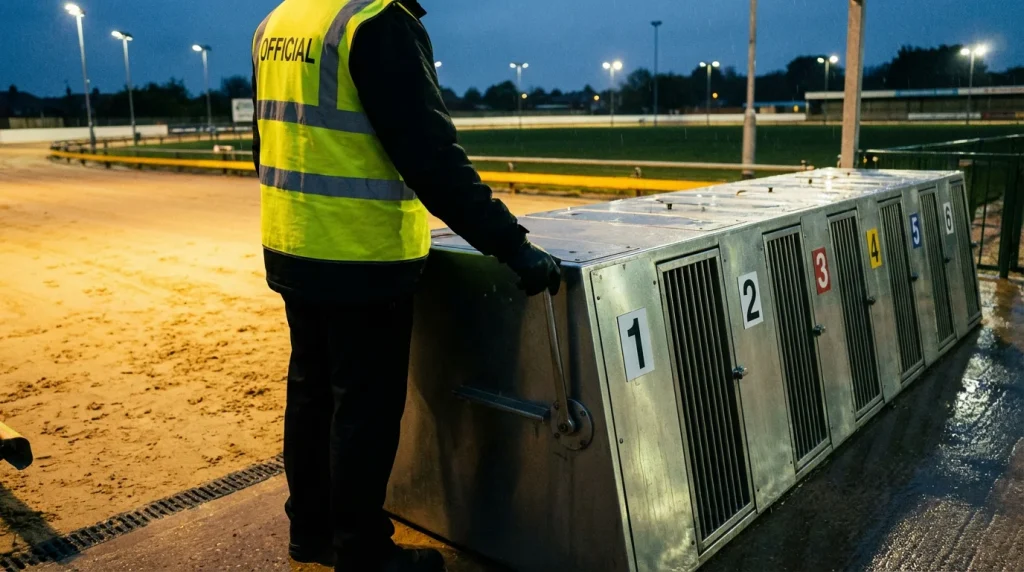
On the evening of racing, each dog is kennelled at the track and undergoes pre-race checks including weighing and identity verification. The dogs are paraded before each race so that on-course spectators can view them, and they’re loaded into the numbered traps in the order published on the racecard. The mechanical hare begins its circuit, the traps open, and the race starts.
The race is recorded on camera, and a photo-finish system is available for close results. The judge declares the official finishing order, including distances between the first three finishers. This result is provisional until the stewards confirm it — a process that typically takes a few minutes during which any objections are considered. Once confirmed, the result becomes official and betting settlements are processed.
The standard race distance and track details — going, weather, time of race — are recorded as part of the official result. These data points feed into the form record and are available through racecards for subsequent races. The official time recorded for the winner and other finishers is the actual run time, not adjusted for conditions — the calculated time that adjusts for going is a separate figure provided by form services rather than the official record.
Non-Runners & Reserves
Non-runners are one of the most common rule-based events that affect greyhound bets. When a dog is withdrawn after the racecard has been published and betting markets are open, the remaining field changes, and the bookmaker’s response depends on when the withdrawal occurs.
If a dog is withdrawn early — before prices have been widely available — the market is simply re-priced with the remaining runners. If a dog is withdrawn late — after a significant market has formed — a Rule 4 deduction may apply. Rule 4 deductions reduce the payout on winning bets to account for the removal of a runner from the field, on the basis that the remaining dogs have an improved chance of winning with fewer competitors.
The deduction scale depends on the non-runner’s odds at the time of withdrawal. A non-runner that was priced at 2/1 triggers a larger deduction than one priced at 10/1, because the shorter-priced dog’s removal has a greater impact on the remaining runners’ win probabilities. Deductions can range from 5p in the pound for a long-priced withdrawal to 45p in the pound for a very short-priced one.
Reserve runners may replace a non-runner at some meetings, depending on the race type and the track’s operational procedures. If a reserve takes the vacant trap, the race runs as a full six-runner field and no deduction applies. If no reserve is available, the race runs with a vacant trap and deductions are applied. The presence of a vacant trap can also alter the race dynamics — the dogs adjacent to the empty box have more room at the break, which can affect early positioning.
For bettors, the key discipline is checking for non-runners before the race. A late withdrawal that changes the race from six runners to five can significantly alter the value of your selection. If you’ve backed a dog each way and the field drops to four runners, the place terms might change or the each way option might be voided entirely, depending on the bookmaker’s rules. Always verify the final field before a race, and understand how your bookmaker handles non-runners and reduced fields.
Objections & Stewards’ Inquiries
After the judge declares the provisional result, there’s a brief window during which the stewards can initiate an inquiry or a trainer can lodge an objection. In greyhound racing, objections are relatively rare compared to horse racing, but they do occur and they can change the official result.
The most common grounds for an objection are interference during the race — a dog impeding another’s progress through crowding, crossing, or bumping. The stewards review the race footage and decide whether the interference materially affected the finishing order. If they determine it did, they can reverse the places of the dogs involved, which changes the official result and, consequently, the settlement of bets.
Stewards’ inquiries can also be initiated by the officials themselves, without a trainer’s objection. If the stewards observe an incident during the race that they believe warrants examination — a dog running across the track, a suspected foul, or any breach of the running rules — they’ll call an inquiry and review before confirming the result.
For bettors, the practical implication is that a race result isn’t final until the stewards confirm it. Most results are confirmed within minutes, and the vast majority stand as called by the judge. But in cases where there was visible interference, it’s worth waiting for confirmation before assuming you’ve won or lost. Bookmakers settle on the official result as confirmed by the stewards, not the provisional judge’s call.
The Rules You Don’t Read
The full GBGB rules of racing run to hundreds of pages. Most bettors will never need to consult them directly. But the handful of rules that affect settlements — non-runner deductions, void race provisions, objection procedures, and the conditions under which each way terms apply in reduced fields — are worth understanding before they surprise you on a busy evening. The rules exist to make the sport fair. Knowing them means you can bet with your eyes open, rather than discovering the small print at the moment it costs you money.