Greyhound Weight Changes: What Racing Weight Tells You
Best Greyhound Betting Sites – Bet on Greyhounds in 2026
Loading...
Weight Is a Whisper — If You Know How to Listen
A kilo up or down is a signal, not noise. Every greyhound is weighed before it races, and that figure is printed on the racecard alongside the dog’s form, trap draw, and trainer details. Most bettors glance at it and move on. The sharp ones pay closer attention, because weight changes between runs can indicate shifts in fitness, health, or condition that the form figures haven’t yet reflected.
Greyhounds are lean, muscular athletes racing at close to their physical limits. Even small changes in body mass can affect performance — not dramatically in most cases, but enough to tip the balance in a competitive field where margins are measured in fractions of a second. A dog that’s half a kilogram heavier than its last run might be carrying extra muscle from peak training, or it might be slightly over-conditioned and less sharp. A dog that’s dropped a kilo might be lean and race-fit, or it might be stressed and underweight.
The number alone doesn’t tell you which scenario applies. But combined with the rest of the form picture — recent results, sectional times, trainer patterns — weight becomes a useful confirming or warning signal that adds depth to your analysis.
How Weight Is Recorded on Greyhound Racecards
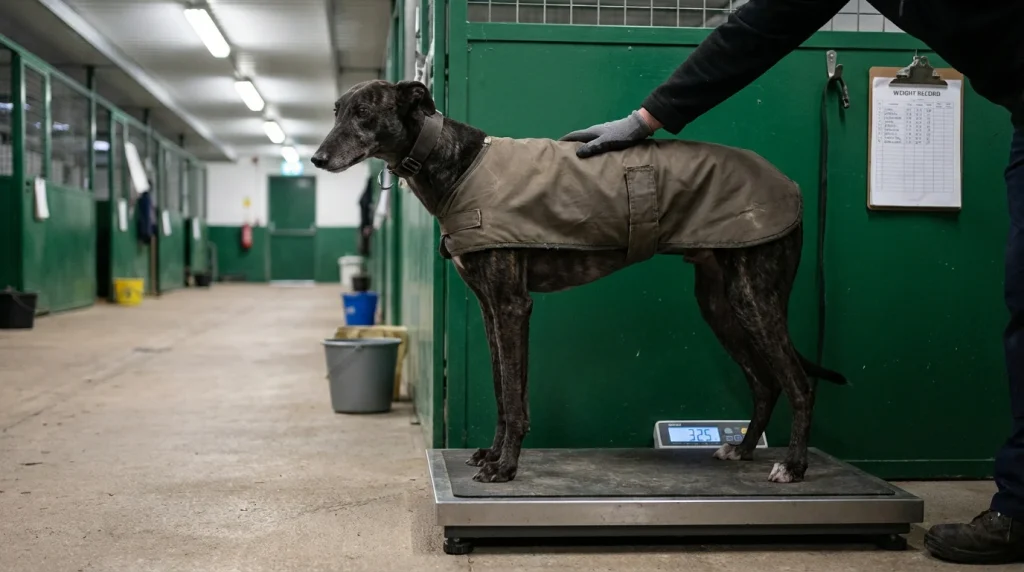
Every racecard shows the dog’s racing weight, measured in kilograms and recorded at the track before each race. The weighing is conducted by track officials as part of the pre-race checks mandated by the GBGB, and the figure is official and standardised across all licensed UK venues.
On a typical racecard, you’ll see the current weight alongside the weights from the dog’s recent runs. This historical weight data is what makes the information useful — a single weight figure means nothing in isolation. It’s the comparison between runs that reveals changes. A dog showing 32.5 kg today after 32.0 kg in its last race and 31.8 kg in the race before that has been gaining weight steadily across three outings, and that pattern warrants attention.
The weight is taken under controlled conditions — the dog is weighed at a consistent time before the race, after being walked but before any extended warm-up. This standardisation means that variations between weighings primarily reflect genuine changes in the dog’s body composition rather than temporary fluctuations from hydration or recent feeding. That said, greyhound weights can fluctuate by a few hundred grams between consecutive races without signifying anything meaningful. The patterns that matter are the sustained trends over three or more runs.
Some online form guides and racecard services display the weight change explicitly, showing a “+0.5” or “-0.3” next to the current weight. This saves you the arithmetic but can also draw attention to minor fluctuations that don’t merit concern. Develop your own threshold for what constitutes a significant change — generally, anything over half a kilogram across two consecutive runs is worth investigating further.
What Weight Gains & Losses Indicate
Weight gain can mean fitness. Or it can mean trouble. The interpretation depends entirely on context, which is why weight data needs to be read alongside other form indicators rather than in isolation.
A moderate weight gain — say 0.3 to 0.7 kg — in a dog that’s been running well and showing improving form often signals peak condition. The dog is eating well, training well, and carrying healthy muscle mass. Trainers in form tend to present their dogs at slightly above their minimum racing weight because the extra mass reflects the physical benefits of consistent work. This kind of gain, paired with good recent times and positive race comments, is a bullish signal.
A larger weight gain — a kilogram or more between runs — is more ambiguous. It might indicate that the dog has had a break from racing and has been rested, which could mean it’s returning fresh or returning ring-rusty. It might reflect a change in training regime, a switch in diet, or a recovery from a minor issue. If the gain appears suddenly after a string of consistent weights, it’s worth treating it as a question mark until the dog’s next run provides clarification.
Weight loss follows a similar dual-meaning pattern. A small drop in weight heading into a race can indicate that the trainer has sharpened the dog up — reduced body fat, increased speed work — for a specific target race. Some trainers deliberately bring their dogs in slightly lighter for sprint races where carrying extra mass is a disadvantage. This kind of strategic weight management is common among experienced kennels and is a positive indicator when paired with strong recent trials or form.
Progressive weight loss across three or more races, however, is a warning sign. A dog shedding weight consistently without an obvious training explanation might be dealing with a health issue, digestive problems, or the kind of chronic stress that erodes racing condition. This pattern is particularly concerning if it coincides with declining form — slower times, worse finishing positions, negative race comments. The combination of falling weight and falling performance is one of the strongest avoid signals in greyhound form analysis.
One pattern that experienced bettors watch for specifically is the weight bounce. A dog that’s dropped weight over several runs and then shows a gain is potentially turning the corner — returning to condition after a period of decline. If the weight gain coincides with a move to a lower grade (giving the dog an easier task) and a favourable trap draw, the combination can produce value. The market may still be pricing in the recent poor form while the weight trend is suggesting that improvement is coming.
When Weight Matters Most
Sprints are less affected. Staying races amplify every gram. The relationship between weight and performance isn’t uniform across all race types, and understanding where it matters most helps you allocate your analytical attention efficiently.
In sprint races over 265 to 285 metres, the race is so short that small weight variations have minimal impact. The decisive factors in sprints are trap speed and first-bend position — pure explosive pace — and a few hundred grams of body weight barely registers against those qualities. A sprint specialist carrying an extra half-kilo might lose a hundredth of a second out of the traps, but the effect is negligible compared to the influence of trap draw and early pace.
Over standard middle distances of 400 to 480 metres, weight starts to matter more. The race involves four bends and a finishing straight, and a dog needs to sustain its speed for approximately twenty-eight to thirty seconds. Extra weight imposes a cumulative energy cost over those bends and that straight. A dog that’s a kilogram heavier than its best racing weight might begin to feel the difference in the final hundred metres, losing the sharpness that separates winning from placing.
Staying races over 630 metres and beyond are where weight exerts its strongest influence. These races demand sustained effort over six bends and two full circuits of the track, lasting forty seconds or more. Every additional gram requires energy to carry through every stride of that extended trip. Dogs that are overweight for a staying race tire visibly in the final straight, and the form book is full of stayers that finished strongly when light and faded when heavy. If you bet on staying races regularly, weight monitoring is not optional — it’s essential.
Weight also interacts with track conditions. On a heavy, rain-soaked surface, every dog works harder to maintain speed, and the metabolic cost of carrying extra weight increases. A dog that’s comfortable at 33 kg on a standard surface might struggle at the same weight on a heavy track. Conversely, a very light dog on a fast surface might benefit from marginally more body mass to maintain traction through the bends.
Scales Don’t Pick Winners
Weight is one variable. Not the only one. It would be a mistake to overemphasise weight data at the expense of form, pace, grade, draw, and trainer signals. A dog that’s gained a kilo but has been drawn in a poor trap against stronger opposition isn’t suddenly a selection because of its weight trend. The weight information adds texture to the overall picture — it confirms or challenges the narrative suggested by the rest of the form.
Think of weight as a supporting character in the analysis, never the lead. A positive weight trend paired with improving form and a favourable race setup is a compelling combination. A negative weight trend alongside declining form is a strong avoid. And a weight change on its own, without corresponding form evidence, is a note for next time — a prompt to watch the dog’s next run more carefully before committing money. The best greyhound bettors are the ones who collect these small signals and let them accumulate into conviction, rather than acting on any single data point in isolation.