Greyhound Trap Draw Statistics UK: Does Position Matter?
Best Greyhound Betting Sites – Bet on Greyhounds in 2026
Loading...
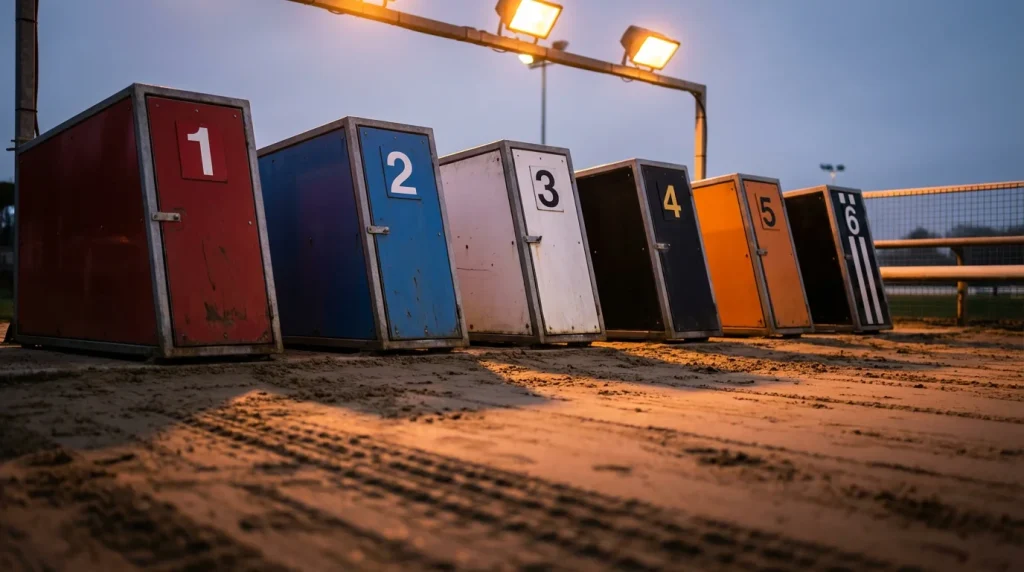
Trap Number Is the First Thing You See — And the First Thing Most Bettors Misread
Red jacket, inside rail, and a reputation that exceeds the data. Trap 1 carries more mystique in greyhound racing than any other starting position. Ask a casual punter which trap wins most and they’ll say trap 1 without hesitation. Ask them by how much and the answer usually falls apart.
Every greyhound race in the UK features six traps, each assigned a fixed colour: red for trap 1, blue for 2, white for 3, black for 4, orange for 5, and black-and-white stripes for trap 6. These aren’t just cosmetic — they are mandated under GBGB Rule 118. The trap number determines where a dog starts relative to the inside rail, and on an oval track with bends, that geometry matters. The inside dog has less ground to cover on the turns. The outside dog has more room to run but a longer path. In theory, this should give lower-numbered traps an edge.
In practice, the advantage exists — but it’s smaller than most people assume, and it varies wildly between tracks. Some venues produce a genuine inside bias that can be measured over thousands of races. Others are so well-designed that the trap draw barely registers as a factor. The trouble is that punters tend to apply a blanket assumption across every track, treating trap 1 as an automatic positive and trap 6 as a handicap. That’s where the misreading begins.
Understanding trap draw statistics properly means looking at the numbers track by track, race distance by race distance, and resisting the urge to simplify. The draw is one factor among many — but it’s the one that’s hardest to ignore because it’s literally the first thing printed on the racecard.
UK-Wide Trap Win Percentages
Here are the numbers. They’re more even than you’d expect. Across all GBGB-licensed tracks in the UK, aggregated over full racing seasons, the win distribution by trap typically looks something like this:
| Trap | Colour | Approximate Win % |
|---|---|---|
| 1 | Red | 18–20% |
| 2 | Blue | 17–18% |
| 3 | White | 16–17% |
| 4 | Black | 16–17% |
| 5 | Orange | 15–16% |
| 6 | Stripes | 14–16% |
In a perfectly equal race, each trap would win 16.67% of the time. The reality shows a mild gradient favouring the inside, but no trap is dramatically ahead. Trap 1 wins roughly one in five races. Trap 6 wins roughly one in six or seven. The difference amounts to perhaps two or three percentage points — meaningful over a thousand races, but barely noticeable on any given evening.
These aggregated numbers are useful as a baseline but dangerous as a betting tool on their own. They blend together tight sprint tracks where inside rail advantage is significant and longer-distance galloping tracks where it barely applies. They mix graded races with open races, where the quality of dogs complicates any draw-based analysis. And they smooth over the specific track geometries — bend sharpness, run-up distances, and the positioning of the first turn relative to the traps — that actually create the bias in the first place.
The aggregate tells you that inside traps win slightly more often across the sport as a whole. What it doesn’t tell you is whether that edge applies at the track you’re betting on tonight. For that, you need track-level data.
One common mistake is treating these percentages as fixed probabilities. Bookmakers already price in trap draw advantage. If trap 1 is known to win 20% of the time at a specific venue, the market accounts for it. The value doesn’t come from knowing that trap 1 has an edge — it comes from knowing when the market has overpriced or underpriced that edge relative to the specific dog drawn there.
Track-by-Track Trap Bias
The aggregate hides the extremes. Strip back the national average and look at individual venues, and the picture becomes considerably more interesting — and more useful.
At Monmore Green in Wolverhampton, trap 1 has historically outperformed the other five positions by a significant margin, particularly over the standard 480-metre distance. The track configuration features a relatively sharp first bend that sits close to the starting traps, which naturally advantages the inside dog. A greyhound breaking cleanly from trap 1 at Monmore can hug the rail through the first bend with minimal interference, while dogs drawn wider need to either show exceptional early pace or risk being squeezed out. Over years of data, trap 1 at Monmore has produced win rates noticeably above the national average.
Romford tells a similar story, though the pattern shifts depending on race distance. Over the shorter sprint distances, traps 1 and 2 carry a pronounced advantage because the first bend arrives almost immediately. There’s no long straight to sort out positions before the turn, so the inside dogs get to the rail first simply by virtue of geometry. Over the longer distances at the same track, the bias softens because the field has more time to settle before the first bend.
Contrast that with Towcester, which operates as one of the UK’s largest circuits and hosts the English Greyhound Derby. The generous bends and longer run to the first turn mean that outside draws are far less of a disadvantage. Dogs drawn in traps 5 and 6 at Towcester have more room and more time to find their position, and the win percentages across traps are considerably flatter than at tighter venues.
Hove, on the south coast, is another venue where trap bias varies by distance. The two-bend sprint races over 285 metres tend to favour inside draws heavily, but the standard 500-metre races over four bends produce a more balanced distribution. Perry Barr in Birmingham leans towards the inside over middle distances but shows less bias in its staying races, where the longer trip reduces the significance of the initial bend position.
Crayford is an interesting case. It’s a relatively tight track but with a longer run-in from the traps to the first bend compared to Romford. This means dogs drawn wide have a fractional extra moment to establish their position. The trap bias at Crayford is present but milder than you’d expect given the track dimensions.
Newcastle, Sunderland, and Doncaster in the north each have their own profiles. Newcastle’s trap 1 has performed strongly over the standard distance, while Sunderland’s bias has historically been more moderate. Doncaster has shown periods where trap 6 underperforms substantially and other seasons where the difference evens out — a reminder that track maintenance, rail positioning, and even sand composition can shift bias patterns over time.
The practical takeaway is straightforward: you cannot apply a single trap bias model across the UK. Each track produces its own data, and that data can change with track renovations, distance alterations, or shifts in the racing programme. The punters who profit from trap draw information are the ones who maintain track-specific records and update them regularly.
How to Use Trap Bias in Your Selections
Trap bias is a modifier, not a selection method. It should adjust your assessment of a runner, not replace it. A dog with poor recent form doesn’t become a betting proposition simply because it’s drawn in trap 1 at a track with inside bias. But a dog with solid form that also lands a favourable draw has a genuine edge that may not be fully reflected in the price.
The most effective way to incorporate trap data is as a final filter. Start with your form analysis: recent runs, sectional times, grade movements, trainer performance. Identify the dogs you rate as contenders. Then check the draw. If your top-rated runner also has the draw in its favour, that’s a reinforcing signal. If your fancied dog is drawn in a known weak trap at that specific track, it doesn’t mean you abandon the selection — but you might adjust your staking or look more carefully at whether the price compensates for the positional disadvantage.
Where trap bias becomes genuinely actionable is in races where two or three dogs appear closely matched on form. In a tight race at a venue with strong inside bias, the dog drawn in trap 1 or 2 has an edge that can tip the balance. Conversely, at a track where bias is negligible, the trap number should carry almost no weight in your final decision.
A useful exercise is to build a simple spreadsheet that tracks trap win percentages at the venues you bet on most frequently. Record the results of every race at that track over a period of months. Split the data by distance, because bias can be distance-specific. Over time you’ll develop a localised picture that’s far more actionable than any national average.
Be cautious about small sample sizes. Fifty races at a track isn’t enough to draw reliable conclusions about trap bias. You need hundreds, ideally a full season’s data, before the patterns stabilise. Short-term fluctuations can make it look like trap 5 is suddenly dominant at a venue where it historically isn’t — that’s noise, not signal.
One more consideration: early prices often don’t fully account for track-specific bias, especially in BAGS racing where the markets are less liquid and less scrutinised. Evening meetings at major tracks tend to be priced more efficiently because more money flows through those markets. If you’re looking for trap-related value, the quieter daytime meetings are often where it hides.
When the Trap Tells You Nothing
Some dogs make their own luck from any box. A greyhound with exceptional early pace can break from trap 6 and still reach the first bend in front, negating any inside draw advantage. These are the dogs that bend the statistics — literally. When a strong early-pace runner is drawn wide, the trap bias data for that race becomes almost irrelevant because the dog’s speed overrides the geometry.
Open races present another scenario where trap data loses its predictive power. In graded racing, the fields are designed to be competitive, which means small edges like trap draw can tip outcomes. In open races, the variation in dog quality is often larger, and a clearly superior animal will win regardless of starting position. The same applies when a recently re-graded dog drops into a significantly weaker grade — the class gap matters more than the draw.
Races with multiple non-runners also distort trap bias. If traps 3 and 5 are vacant, the surviving dogs have altered spacing and different crowding dynamics at the first bend. Historical bias data assumes a full six-runner field, so when two dogs are scratched, those percentages don’t apply in the same way.
Trap draw statistics are a genuine tool in greyhound betting, and ignoring them entirely means ignoring free information. But treating them as destiny is equally misguided. The best use of trap data sits somewhere in between: as one calibrated input in a broader assessment, weighted according to the specific track, distance, and field composition of the race in front of you. Know the numbers. Know where they apply. And know when to set them aside.