UK Greyhound Racing Tracks: Every Licensed Venue, Distances & Betting Stats
Best Greyhound Betting Sites – Bet on Greyhounds in 2026
Loading...
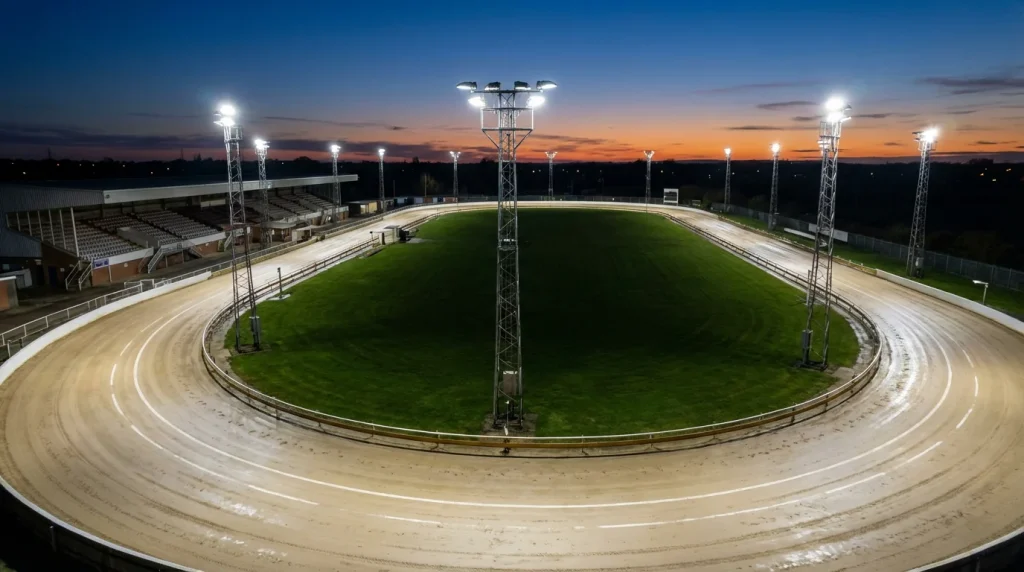
Every Track Has a Personality — Here’s How to Read It
A 480-metre race at Romford is a different test to 480 at Towcester. The distance is the same. Almost everything else — the circumference of the circuit, the length of the run to the first bend, the tightness of the turns, the surface profile, the way traps translate into early positioning — is different. And those differences change which dogs win.
The UK currently has 18 active GBGB-licensed greyhound stadia, concentrated in England with a single track in Wales. That’s down from nearly eighty licensed venues in the 1940s and over twenty as recently as the 2010s. The sport is contracting, but the tracks that remain each carry distinct physical characteristics that directly affect race outcomes and, by extension, betting value. Knowing those characteristics is an edge. It’s not a marginal one, either — track knowledge separates bettors who understand why a dog ran a certain way from those who simply note that it did.
This guide profiles every active licensed track in the UK, grouped by region. For each, we cover the key physical attributes that matter for betting: circuit size, run to the first bend, standard racing distances, notable trap biases, and the general character of the track. Some tracks favour front-runners and inside railers. Others reward dogs with a wide-running style and late stamina. A few are genuine galloping circuits where class tends to prevail over draw. Understanding which is which is the foundation of track-specific betting.
Track Profiles: London & South East
London’s tracks run hot and fast — starting with Romford. Romford Greyhound Stadium, owned by Coral, is one of the UK’s most high-profile venues and hosts several Category One open races including the Coral Essex Vase over 575 metres. The track circumference is relatively tight, with a short run to the first bend that heavily favours early pace and inside trap draws. Standard distances include 225m, 400m, 575m, and 750m. The short run-in means that dogs drawn in traps 1 and 2 have a natural advantage — they can reach the rail first and hold position through the bends. Dogs drawn wide need exceptional early speed to compensate, or they’ll be forced to race around the field. For bettors, Romford is a track where the trap draw is a primary consideration rather than an afterthought.
Crayford sat in south-east London and provided a contrast before its closure in January 2025. The circuit was larger than Romford’s, with a longer run to the first bend that allowed wider-drawn dogs more time to find position. Racing distances included 380m, 540m, 714m, and hurdles over 380m. Crayford was considered a fairer galloping track — less dominated by the inside traps, with more emphasis on sustained pace and stamina. The Golden Jacket, a premier staying event at 714m, was one of its flagship races. For dogs with middle-distance or staying ability, Crayford was often where their form read most honestly.
Hove, on the south coast near Brighton, features sweeping bends and a well-regarded racing surface. Distances include 285m, 500m, 695m, and 880m, with the Coral Brighton Belle and Sussex Cup among its notable events. The generous bends mean that dogs which handle turns poorly at tighter tracks can sometimes perform markedly better here. Hove also benefits from a committed local following and regular evening cards that draw competitive fields.
Central Park in Sittingbourne, Kent, has been reinvigorated in recent years and hosts open events including the Arena Racing Company Cesarewitch over 731m and the Kent Plate over 491m. The track offers a solid range of distances. Harlow, further north in Essex, operates a smaller circuit with distances starting at 238m for sprints through to 946m. It’s one of the more compact tracks in the region and caters heavily to BAGS daytime racing, which means fields can be less competitive than the evening cards at Romford or Hove.
Track Profiles: Midlands & North
The Midlands is where most of the UK’s volume racing happens. Monmore Green in Wolverhampton is a tight, sharp circuit that emphatically favours inside runners and early pace. The run to the first bend is short, and dogs drawn in traps 1 and 2 have a documented statistical advantage that exceeds the national average. Distances include 264m, 480m, 630m, and 684m. The Ladbrokes Winter Derby, held at Monmore over 480m, is a major midwinter event. If you’re betting at Monmore, the trap draw should be your first filter — dogs drawn wide without exceptional early speed are fighting the track’s geometry from the moment the traps open.
Perry Barr in Birmingham offered a bigger circuit with a 435-metre circumference and a 60-metre run to the first bend before its closure in August 2025. This made it one of the fairer tracks in the Midlands, with distances ranging from 275m to 895m. The longer distances provided genuine staying tests that some other tracks can’t accommodate. Perry Barr’s racing operation has been transferred to the new Dunstall Park Greyhound Stadium at Wolverhampton Racecourse, which opened in September 2025.
Nottingham, racing from the Colwick Park track, is widely regarded as one of the fairest circuits in the country. The 500m standard distance, used for the BGBF British Breeders Stakes, runs over a course where bend geometry doesn’t disproportionately favour either rail. It’s a track where form tends to read more honestly than at tighter venues — which, for bettors, means racecard data is a more reliable guide here than at tracks where the draw distorts outcomes.
Sheffield operates from Owlerton Stadium with distances including 280m, 500m, 660m, and 900m. The Gymcrack, a long-standing puppy event over 500m, is its most notable race. Doncaster, at the Stainforth Lane venue, offers 270m sprints through to longer distances and handles a significant BAGS workload. Newcastle, at Brough Park, is the most northerly GBGB track and races over distances from 280m to 934m with a good range of open events including the Northern Puppy Derby and the Angel of the North. Sunderland, at Pelaw Grange, completes the northern picture with a 345-metre circumference and a notably long 90-metre run to the first bend — one of the longest in the country, which means wide-drawn dogs have more time to find position than at most venues.
Track Profiles: Other Regions
Outside the big cities, smaller tracks carry their own quirks. Towcester, in Northamptonshire, stands apart as the home of the English Greyhound Derby — the sport’s premier event, with a winner’s prize of £175,000. The circuit is one of the largest in the UK, with standard distances of 270m, 500m, and 712m, plus marathon events over 943m. Towcester’s size and sweeping layout make it a true galloping track where class usually prevails over trap advantage. The TV Trophy, the Blue Riband, and the Derby itself all take place here, and the venue attracts entries from across England and Ireland. For bettors, Towcester’s open race calendar makes it the most important single track in UK greyhound racing.
Oxford, at the Cowley venue, races over 285m, 450m, 650m, and 835m and hosts the bet365 Hunt Cup and the BGBF Puppy Cup. It’s a mid-sized circuit that handles both BAGS daytime cards and competitive evening meetings. Peterborough, operating from Fengate, provides sprint racing from 250m and middle distances up to 620m. Yarmouth, on the east coast, has a 382-metre circumference and races over distances from 277m to 1041m — the marathon distance being among the longest in the country, creating a genuine stamina test found at very few other venues.
Kinsley, in West Yorkshire, is a compact track with a BAGS-focused schedule. Henlow, in Bedfordshire, was a long-standing fixture in UK greyhound racing. The Valley Greyhound Stadium at Ystrad Mynach in Wales is the only GBGB-licensed track outside England — though its future is uncertain, with the Welsh Government’s Prohibition of Greyhound Racing (Wales) Bill progressing through the Senedd and a ban expected to take effect no sooner than 2027. If the ban proceeds, the active number of GBGB stadia will drop further, concentrating the sport entirely in England.
Track Distances: A Comparative Reference
One table. Every track. Every distance. UK greyhound racing distances fall into four broad categories: sprint (roughly 238-305m), standard or middle distance (380-550m), staying (590-750m), and marathon (835m and above). Not every track offers all four categories. Some specialise in standard distances with limited sprint or staying options. Others — Towcester, Perry Barr, Newcastle, Yarmouth — offer the full range from short sprints to marathons.
Sprint races, typically held over 264-285m at most tracks, are often settled in the first two or three seconds. Early pace from the traps is decisive, and the trap draw carries its greatest influence in these races because there are fewer bends for dogs to recover lost ground. Standard distances around 480-500m represent the backbone of UK greyhound racing — most graded races are run over these trips, and they provide the best balance between early speed and sustained pace. Staying races over 630-714m test stamina and racing intelligence, rewarding dogs that settle into a rhythm and maintain effort through multiple bends. Marathon events beyond 835m are specialist territory and are only offered at a handful of tracks.
For betting purposes, the distance category shapes the market. Sprints are more volatile — a slow break from the traps can end a dog’s chance before the first bend. Standard distances offer the most form reliability, which is why they’re the most popular race type for serious form analysts. Stayers’ races tend to produce fewer surprises because stamina is a more consistent trait than early speed, and the longer the race, the less influence the trap draw typically has. Matching your betting approach to the distance is as important as matching it to the track.
Trap Bias by Track: Where Draw Advantage Exists
Trap bias isn’t a theory at some tracks — it’s a pattern in the numbers. Across UK greyhound racing, trap 1 (the red jacket, closest to the inside rail) wins more often than any other trap position when measured as a national aggregate. The typical range is 18-20% for trap 1 versus 14-16% for trap 6 (the striped jacket, widest draw). In a perfectly fair sport, each of the six traps would win approximately 16.7% of the time. The deviation from that baseline isn’t random — it reflects the physical geometry of each track.
Tracks with a short run to the first bend — Monmore and Romford being the clearest examples — show the most pronounced inside bias. At these venues, the first bend arrives so quickly that dogs in traps 1 and 2 can secure the rail before wider-drawn dogs have time to find position. The advantage compounds through the rest of the race because the rail saves ground on every bend. Over hundreds of races, this produces a statistically significant gap in trap win percentages that is too consistent to dismiss as coincidence.
Tracks with a longer run-in before the first bend — Sunderland with its 90-metre approach, or Nottingham with its generous layout — show a flatter distribution across trap positions. The extra metres give outside dogs time to drift in or use their early speed to reach a competitive position before the first turn. At these venues, trap bias still exists but is muted, and other form factors carry relatively more weight in determining outcomes.
Some tracks show quirks in specific distance categories. A track might have minimal trap bias over its standard 480m distance but a pronounced inside advantage over 264m sprints, where the run to the first bend is proportionally much shorter. This is why blanket statements about trap bias are misleading — the bias operates at the intersection of track and distance, not just track alone. When you see a dog drawn in trap 1 at Monmore over 264m, the draw advantage is substantial. The same dog in trap 1 at Towcester over 500m faces a track where the draw matters far less.
Using trap bias data effectively means integrating it into your assessment rather than treating it as a standalone selection method. A dog with strong form drawn in a favourable trap gets a bump. A dog with strong form drawn against the bias needs to be considerably better than the opposition to overcome the positional disadvantage. Neither piece of information works well in isolation. Together, they sharpen your assessment in a way that most punters — who either ignore the draw entirely or over-weight it — miss.
Trap bias data by track and distance is published by several statistical services and can also be compiled manually from results archives. The effort is modest and the data is cumulative — the more races you track, the more reliable the patterns become. For any track you bet on regularly, having a working knowledge of its trap bias profile is not optional. It’s foundational.
Surface, Weather & Track Conditions
UK tracks run on sand. But not all sand tracks run the same. The vast majority of GBGB-licensed stadia use sand-based surfaces, with grass tracks having essentially disappeared from the licensed circuit. Sand provides a more consistent and safer surface than grass, but it responds to weather conditions in ways that affect race times and suit certain running styles over others.
Rain softens the sand, which generally slows run times across the board. A heavy downpour before a meeting can add several tenths of a second to times compared to a dry, fast surface. The track variant — the adjustment applied to raw times to produce calculated times — accounts for this, but if you’re comparing times across meetings without using calculated figures, weather is a variable you need to factor in manually. Some dogs perform better on a slower, rain-affected surface because it suits their grinding running style. Others are at their best on fast ground where early pace is rewarded.
Temperature also plays a role, though it’s subtler. Cold, compacted sand in winter tends to ride faster than the softer surface that develops in warmer months. Tracks maintain their surfaces between meetings, watering and harrowing the sand to achieve a consistent going, but conditions within a single evening card can change — races later in the programme may run slightly differently than earlier ones, particularly if rain arrives mid-meeting. For most bettors, the practical takeaway is to check conditions before committing to selections based purely on time comparisons, and to prefer calculated times over raw times whenever they’re available.
BAGS vs Evening Racing: Which Tracks Run When
BAGS racing is the industry’s bread and butter — and it has its own form logic. BAGS stands for Bookmakers’ Afternoon Greyhound Service, and it refers to daytime meetings staged primarily to supply content for betting shops and online bookmakers. These meetings are funded by the bookmaking industry and typically run from late morning through to early evening, scheduled to fill the gaps between horse racing cards.
Not every track runs BAGS meetings. The regulars include Harlow, Central Park, Doncaster, Kinsley, Monmore, Newcastle, Sunderland, Sheffield, and several others that rotate through the weekly BAGS schedule. Evening racing, by contrast, tends to be the premium product — stronger fields, more competitive grading, higher prize money, and better attendance. Tracks like Romford, Hove, Nottingham, and Towcester host their strongest cards on evening fixtures.
The betting implications are significant. BAGS meetings often feature weaker fields because the racing is more frequent and the pool of available dogs at any given track is stretched thinner. Grading can be less competitive, and form can be more erratic because dogs racing multiple times a week across BAGS cards don’t always perform at a consistent level. For some bettors, this creates opportunity: weaker competition in a small field means that a well-informed opinion carries more weight relative to the market. For others, the unpredictability of BAGS form makes it harder to find reliable value. Either way, treating BAGS and evening form as equivalent is a mistake. They’re different competitions with different dynamics, even when they take place at the same track.
Picking the Right Track for Your Betting Style
Don’t bet blind across fifteen tracks. Know your ground. One of the most common strategic errors in greyhound betting is spreading attention too thin — following BAGS meetings at five different tracks during the day and evening cards at three more, without having genuine knowledge of any of them. Volume isn’t the same as coverage. A bettor who knows Romford inside out — its trap biases, its distance profiles, its trainers, its racing patterns — will consistently outperform someone who dabbles across the entire BAGS schedule.
Tight tracks with pronounced trap bias suit bettors who are comfortable making draw-based adjustments to their form analysis. If you’re disciplined about overlaying trap data onto racecard assessments, tracks like Monmore and Romford will regularly produce situations where the market underestimates the draw advantage. Galloping tracks like Towcester and Nottingham suit form-first analysts — bettors who prefer to let calculated times, grade movements, and racing style drive their selections without the noise of draw distortion.
BAGS specialists develop knowledge of the lower-grade racing at specific tracks and often find value in fields that attract less market attention. Evening specialists focus on the premium cards where field quality is higher and the market is more competitive, which demands sharper analysis but also tends to produce more reliable form patterns. There’s no universally correct approach, but there is a universally correct principle: depth of track knowledge beats breadth every time. Pick your tracks, learn them thoroughly, and resist the temptation to bet on races where your understanding is shallow.
Circuits Close, Memory Stays
The list gets shorter every decade. Wimbledon, the sport’s most famous London venue, closed in 2017. Hall Green in Birmingham shut in 2017. Belle Vue in Manchester — the track where the first modern UK greyhound race was held in 1926 — closed in 2020. Wembley, White City, Harringay, Catford, Walthamstow — all gone, each taking a piece of the sport’s geography with it.
The eighteen tracks that remain carry the weight of a sport that once filled stadiums and drew seventy million spectators a year. That world isn’t coming back. What exists now is smaller, leaner, and in some respects more concentrated — fewer tracks means the ones that survive have to work harder, race more often, and serve a betting market that consumes content at an industrial pace. The Welsh ban, currently working its way through the Senedd, will likely reduce the count further within a few years. Scotland is pursuing similar legislation.
For bettors, the shrinking circuit is both a loss and an opportunity. Fewer tracks means fewer variables to learn, deeper data sets per venue, and a sport whose remaining infrastructure you can genuinely know. The dogs still run. The traps still open. The form still tells a story. And the tracks that remain are worth knowing deeply, precisely because the list of them isn’t going to grow.