Greyhound Grading System UK Explained: A1 to Open Races
Best Greyhound Betting Sites – Bet on Greyhounds in 2026
Loading...
Grading Isn’t a Label — It’s a Matchmaking System
Every greyhound finds its level. That’s the principle behind the grading system, and it’s the reason most UK dog races produce competitive fields rather than one-sided processions. The Greyhound Board of Great Britain oversees a structure designed to match dogs of similar ability against each other, which keeps racing fair for the animals and interesting for the bettors.
Unlike horse racing, where handicapping adjusts the weight a horse carries, greyhound racing uses grades to separate runners into ability bands. A dog that wins its race moves up. A dog that consistently finishes behind moves down. The system is self-correcting: a greyhound will eventually settle into the grade where it’s competitive but not dominant, and that’s where it’ll spend most of its career.
For bettors, understanding how grading works isn’t optional. A dog’s grade tells you who it’s been racing against, how it got there, and whether it’s likely to be facing stronger or weaker competition next time out. Grade changes are among the most reliable predictors of value in greyhound betting, and the punters who ignore them are leaving information on the table.
The Grading Ladder: A1 Through A11
A1 is the top. A11 is where dogs start or fall. The grading system in UK greyhound racing runs from A1, the highest standard of graded racing, down through the numbers to A11 at the lower end. Not every track uses all eleven grades — smaller venues may only operate grades A1 through A6 or A7, simply because they don’t have the volume of dogs to fill cards at every level.
Each track’s racing manager is responsible for grading the dogs that race at their venue. When a greyhound first arrives at a track, it’s assessed based on trial times and any form from previous tracks. It gets allocated an initial grade, runs its first few races, and the grading process takes over from there. A winner typically moves up one grade. A dog that finishes in the lower half of consecutive races may be dropped down. The exact rules vary slightly between tracks, but the principle is universal: performance determines placement.
The grades themselves correspond roughly to time bands over the track’s standard distance. An A1 greyhound at a specific venue will be running times that are faster than an A3 dog at the same track. This is important because grades are track-specific — an A2 dog at Romford is not necessarily the same standard as an A2 dog at Monmore. Different track sizes, surfaces, and distances mean that the times underpinning each grade differ from venue to venue.
Promotion and demotion don’t always follow a simple one-win-up, one-loss-down pattern. Racing managers have discretion. A dog that wins by a wide margin might be promoted two grades rather than one. A dog that finishes second by a nose in a fast-run race might stay in the same grade rather than being penalised for a narrow defeat. This discretion adds a human element to the system that can create both anomalies and opportunities.
For bettors, the key grade movements to watch are recent promotions and recent demotions. A dog that’s just been promoted is stepping into a faster grade against dogs it hasn’t faced before. It might struggle. Equally, a dog dropping down a grade or two is entering a weaker field, which can make it a strong favourite — but the market usually spots this, so the price often contracts accordingly.
The grades between A4 and A7 tend to contain the largest number of runners at most tracks. This is the bread-and-butter of UK greyhound racing: competitive graded races where the dogs are closely matched and outcomes are genuinely uncertain. These middle grades are where form analysis and data carry the most weight, because the ability differences between runners are small enough that factors like trap draw, early pace, and distance suitability can swing results.
Open Races, Puppy Races & Special Events
Open races sit above the grade system. They’re not restricted by ability band, which means any dog can be entered regardless of its graded rating. In practice, open races attract the better dogs at a track — trainers enter their strongest animals because the prize money is higher and the prestige matters for the dog’s career profile.
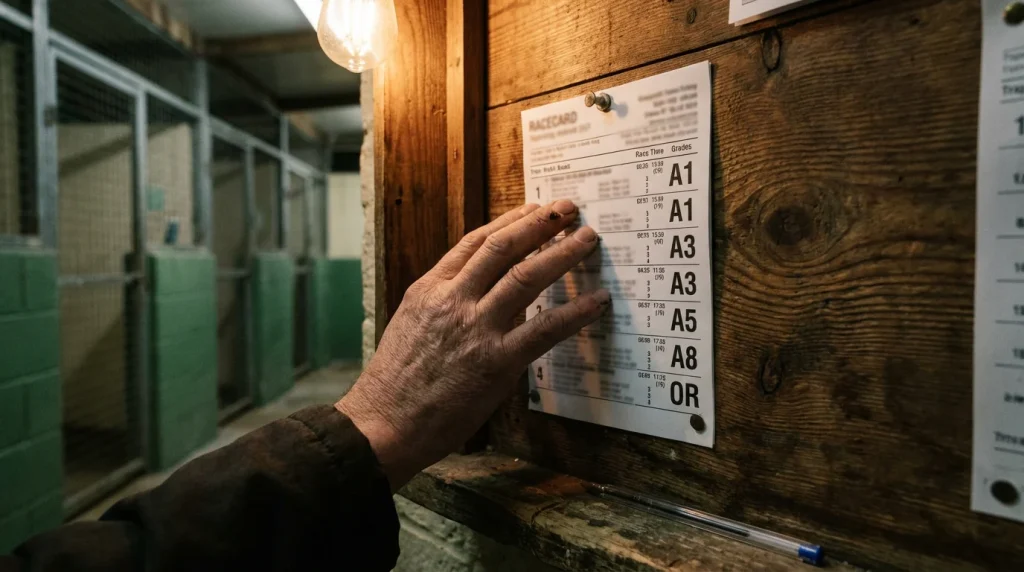
Open races are denoted by “OR” on the racecard and come in various distance categories. A standard open race over 480 metres at a major track will typically feature six dogs of A1 or A2 standard, though occasionally a promising dog from a lower grade gets a shot. The form dynamics in open races differ from graded racing because the fields are hand-picked rather than auto-generated by the grading algorithm. This means you’re more likely to see repeat matchups between dogs that know each other’s running styles.
Puppy races are another category that sits outside standard grading. These are restricted by age — typically for dogs under two years old — and provide a pathway for young greyhounds to gain experience before entering the graded system. Puppy derbies and puppy stakes are popular betting events because the form is less established, which creates volatility and, for sharp bettors, value.
Feature events, including heats and finals for competitions like the English Greyhound Derby, the St Leger, and the TV Trophy, operate on their own entry criteria. These are essentially open-class racing at the highest level, and the dogs competing are typically the top performers from multiple tracks. Betting on feature events requires a different analytical approach because you’re comparing dogs from different venues, different grading systems, and different competitive contexts.
Sprint-only events — races over shorter distances like 265 or 285 metres — also have their own quasi-grading at some tracks. These specialist races attract dogs with exceptional early pace, and the form indicators that matter in sprint events (trap exit speed, first-bend position) are weighted differently than in standard middle-distance racing.
Why Grading Matters for Betting
A dog dropping from A3 to A5 isn’t weaker — it’s in the wrong grade. That distinction is where the betting opportunities live. The grading system creates constant movement: dogs go up, dogs come down, and every shift alters the competitive dynamic of the races they enter.
The most common source of value tied to grading is the recently demoted dog. When a greyhound drops a grade or two, it enters a field where the opposition is measurably slower. If the demotion happened because of one or two unlucky runs — trouble in running, a slow start from an unfavourable trap — rather than a genuine decline in ability, the dog may be significantly faster than its new grade suggests. The market doesn’t always fully price this in, especially in early-morning markets for BAGS racing.
The reverse scenario — a recently promoted dog — requires more caution. A dog that’s won its last two races in A5 and gets bumped to A3 is now facing faster opponents. It might continue winning, but the step up in class is real. Look at the time difference between the dog’s recent wins and the typical winning times in its new grade. If the gap is large, the promotion might be a step too far. If it’s marginal, the dog might be genuine at the higher level.
Grade changes also interact with trap draw in useful ways. A demoted dog drawn in a favourable trap at a track with pronounced bias has a compounding advantage: it’s facing weaker rivals and it has the draw. Conversely, a promoted dog drawn in a historically poor trap faces two headwinds simultaneously. These combined signals are where informed bettors find the clearest edges.
Another pattern to watch is the “grade ceiling” — dogs that repeatedly get promoted, lose at the higher level, get demoted, win again, and get promoted once more. These yo-yo dogs have a natural grade range. If you can identify a dog’s ceiling, you know when to back it (in its comfort grade) and when to avoid it (immediately after promotion). The form figures usually make this pattern visible over six to eight runs.
Trainers also play a role in grading strategy. Experienced trainers understand the system and sometimes manage their dogs’ grade movements deliberately — entering a fast dog in a race where it’s likely to finish mid-pack rather than win, to avoid premature promotion into a grade where it would be outclassed. This is perfectly legitimate within the rules, and spotting it requires familiarity with a trainer’s patterns at a specific track.
The Grade Shuffle
The system keeps the sport fair. It also creates the value. Greyhound grading exists to produce competitive racing, and it does that job well — most graded races feature six dogs with a genuine chance of winning, which is why the sport generates such volume of betting turnover. But every system that creates competitive balance also creates temporary imbalances when dogs move between levels, and those transitions are where the betting edges concentrate.
Grades are not a measure of a dog’s absolute quality. They’re a measure of where it sits in the hierarchy at one specific track at one moment in time. A dog graded A6 at Romford might be A4 standard at a less competitive venue. The grade tells you the context, not the whole story. Combine it with form, trap data, and an understanding of the trainer’s approach, and the grading system transforms from a simple classification into one of the most useful analytical tools in greyhound betting.