Each Way Greyhound Betting: When & How to Use It
Best Greyhound Betting Sites – Bet on Greyhounds in 2026
Loading...
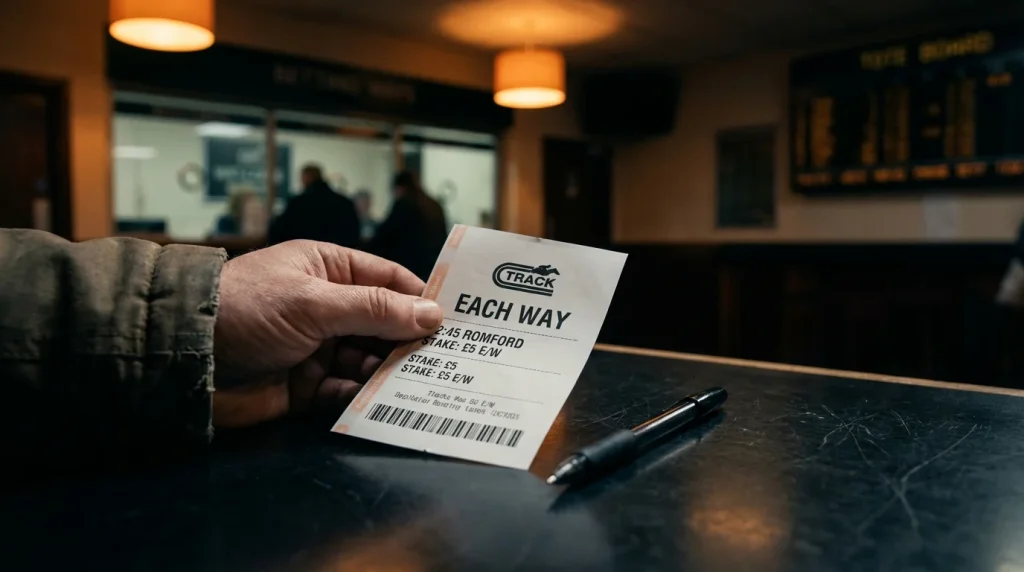
Each Way Isn’t Always a Safety Net
Half the time, each way is a margin donation to the bookmaker. That’s a blunt opening, but it reflects a mathematical reality that most greyhound bettors don’t examine closely enough. The each way bet is one of the most popular selections in UK dog racing — it feels cautious, it feels smart, and it produces returns even when your dog finishes second. What it doesn’t always do is produce value.
Each way betting in greyhound racing works differently than in horse racing, and the difference is structural. With only six runners in a greyhound race compared to fields of ten, fifteen, or twenty-plus in horse racing, the place component of an each way bet operates in a much tighter environment. The place terms — typically quarter the odds for first or second — are less generous in a six-dog race than they would be in a large-field handicap, and the maths reflects that.
None of this means each way bets are always wrong. There are specific scenarios where an each way greyhound bet is the sharpest play available. The skill is identifying those scenarios and avoiding the rest.
How Each Way Works in 6-Runner Greyhound Races
Two places. Quarter the odds. Double the stake. An each way bet is actually two separate bets combined into one. The first is a win bet: your dog must finish first to collect. The second is a place bet: your dog must finish first or second. The place part pays out at a fraction of the win odds — in standard UK greyhound racing, that fraction is one quarter.
If you place a £5 each way bet, your total stake is £10 — £5 on the win, £5 on the place. If your dog wins at 8/1, you collect £40 profit on the win part plus £10 profit on the place part (8/1 divided by 4 = 2/1), giving you £50 profit from a £10 stake. If your dog finishes second, you lose the £5 win stake but collect £10 profit on the place part, netting £5 profit overall.
The arithmetic changes depending on the odds. At shorter prices, the place return shrinks rapidly. A dog at 3/1 each way pays only 3/4 (three-quarters of a unit) on the place. A £5 each way bet on a 3/1 shot that finishes second returns £3.75 on the place minus the £5 lost on the win, leaving you £6.25 down overall on a £10 total stake. This is the trap that catches many bettors: the each way place return at short odds doesn’t come close to covering the lost win bet.
At bigger prices, the equation shifts. A dog at 10/1 each way pays 10/4 (5/2) on the place. A second-place finish returns £12.50 profit on the place against the £5 lost on the win, giving you £7.50 profit. A dog at 16/1 each way pays 4/1 on the place — a second-place finish nets £15 profit. This is where each way starts to make mathematical sense.
The critical threshold for most bettors is around 5/1 or 6/1. Below that price, the place component of an each way bet rarely compensates adequately for the lost win stake when the dog finishes second. Above that price, the place return starts to provide meaningful protection while still allowing significant profit on a win. This isn’t a rigid rule — the dog’s actual probability of placing matters more than any arbitrary price threshold — but it’s a useful baseline.
When Each Way Greyhound Bets Offer Value
Each way pays when a big-priced dog has place credentials. The ideal each way candidate in greyhound racing has a specific profile: it’s priced at 6/1 or longer, it has demonstrated the ability to run prominently without necessarily winning, and the race conditions suggest it will be competitive without being favourite.
Consider a dog priced at 8/1 in a six-runner race. Its recent form shows finishes of 2-3-1-2-3 over its last five runs. It rarely wins outright, but it consistently finishes in the first three. In a competitive A4 or A5 race where no single dog clearly dominates, this kind of profile makes each way attractive. The win part gives you a shot at a decent return if things go perfectly, while the place part is likely to return based on the dog’s demonstrated consistency.
Another good each way scenario is the early-pace dog drawn in a favourable trap at a track with inside bias. Even if this dog doesn’t have the stamina to hold on and win, its ability to lead through the early bends means it’s likely to be in a place position when it matters. The market might not fully price in the combination of early speed and draw advantage, especially at bigger prices.
BAGS racing can produce each way opportunities that evening racing doesn’t, simply because the markets are less efficient. A dog that’s been unlucky in recent runs — trouble at the first bend, bumped wide — might drift to 10/1 or 12/1 despite having the ability to finish in the first two. At those prices, the each way returns are generous enough that even a place-only result is profitable.
The flip side is that each way betting works poorly in races with a clear standout. If one dog is 1/2 favourite and the rest are 6/1 or longer, the favourite is likely to win and the others are scrapping for a single place slot. At those prices, placing doesn’t compensate for the risk. Each way bets thrive in open, competitive races where several dogs have realistic place chances.
When to Avoid Each Way
Short-priced each way is almost never the right play. If a dog is 2/1, the each way place return is just 1/2 — meaning you need a £10 total stake to win £2.50 on the place. If the dog finishes second, you’re down £2.50 overall. If it finishes third or worse, you lose the full £10. At these prices, you’re better off just backing the dog to win, or if you genuinely think it might not win but will be competitive, backing it for a place only with some bookmakers that offer place-only markets on greyhounds.
Heavily skewed markets present a related problem. When the favourite is odds-on and the rest of the field drifts to 6/1 and beyond, your each way outsider is essentially fighting four other longshots for a single remaining place position. The probability maths deteriorate quickly in that scenario.
Avoid reflexive each way betting on every race. Some bettors develop a habit of backing each way because it feels safer than a straight win bet. Over a season of volume betting, this approach drains the bankroll. Each way adds to the total stake on every bet, and the cumulative effect of paying double the unit stake across hundreds of bets is significant. Each way should be a deliberate, calculated choice for specific races — not a default setting.
Similarly, avoid each way accumulators on greyhounds. The combination of compounding margins and the tight six-runner fields makes greyhound each way multiples one of the poorest-value bet types available. The bookmaker’s overround compounds at every leg, and the narrow place terms (1/4 odds for two places) make each way accas extremely difficult to profit from long-term.
The Insurance Trap
Comfort costs money in betting. Each way is the comfortable bet. It softens the blow of a near-miss and provides a return when your dog runs well without winning. That psychological cushion is precisely why it’s so popular — and precisely why it needs scrutiny.
The bettors who use each way most profitably are the ones who treat it as a specific tool rather than a blanket approach. They identify the races where the place component carries genuine mathematical value, they pass on the races where it doesn’t, and they never confuse “feeling better about a second-place finish” with “making a smart bet.” In greyhound racing, where the small fields compress the margins on every bet type, that distinction is the difference between each way being a strategy and each way being a habit.