Betfair Exchange Greyhound Betting: Back, Lay & Trade
Best Greyhound Betting Sites – Bet on Greyhounds in 2026
Loading...
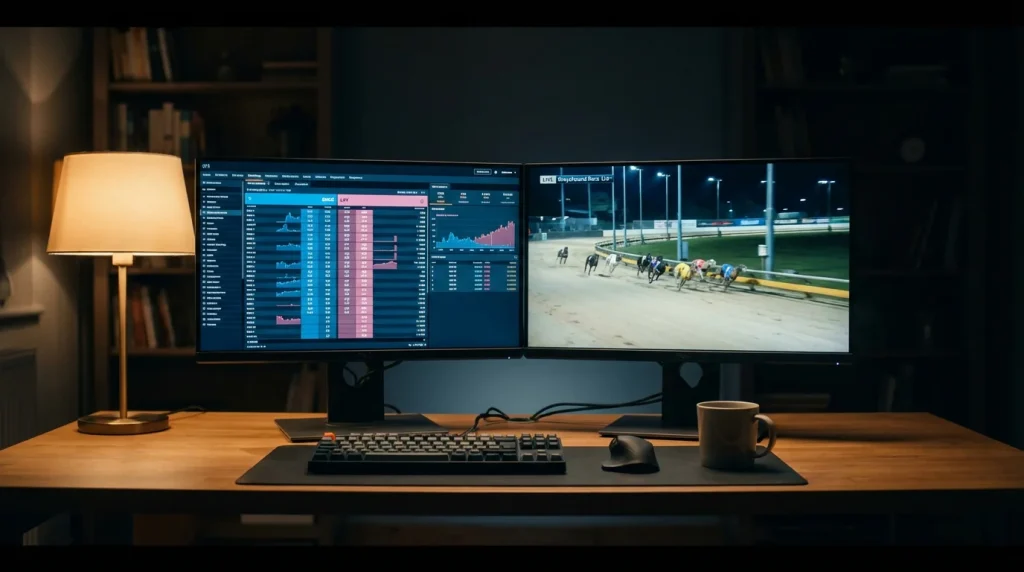
The Exchange Changed How Greyhound Betting Works
Betfair’s betting exchange introduced a fundamentally different model to greyhound wagering. Instead of betting against a bookmaker, you bet against other punters. Instead of accepting the odds a bookmaker sets, you request your own odds or accept those offered by someone else. And instead of being limited to backing a dog to win, you can lay it — bet that it won’t win — opening a dimension of greyhound betting that traditional bookmakers don’t offer.
The exchange model offers theoretical advantages: lower margins, better prices, and more flexibility. In practice, those advantages apply unevenly across greyhound racing. The exchange works brilliantly for some types of greyhound bets and poorly for others, and the distinction comes down to one factor that governs everything on the exchange: liquidity.
How the Exchange Works for Dogs
On the exchange, every bet has two sides. When you back a dog at 4.0 (3/1), someone else is laying that dog at 4.0 — accepting your bet and paying out if the dog wins. When you lay a dog at 4.0, someone else is backing it. The exchange matches these opposing positions and takes a commission on the net winnings of the successful side, typically between 2% and 5% depending on your account activity level.
The commission replaces the bookmaker’s overround as the cost of betting. In a standard bookmaker market, the overround on a greyhound race might be 120-130%, meaning the collective implied probabilities exceed 100% by the bookmaker’s margin. On the exchange, the effective overround is much lower — often between 102% and 106% — because the commission only applies to the winner, not baked into every price. Over thousands of bets, this lower cost translates into better returns for the bettor.
You can set your own price on the exchange. If you think a dog should be 6.0 but the current best available price is 5.0, you can request 6.0 and wait for someone to match your bet. If the market moves in your direction, your bet gets matched. If it doesn’t, the bet expires unmatched and your money is returned. This ability to set your own terms is a significant advantage over fixed-odds bookmakers, where you accept the published price or don’t bet at all.
The exchange also shows the depth of the market — how much money is available at each price. You might see £50 available to back at 4.0, £120 at 3.8, and £30 at 3.6. This transparency tells you not just the price but the confidence behind it. A deep market at a specific price suggests genuine consensus. A thin market suggests the price could move easily.
Liquidity & Market Depth
Liquidity is the exchange’s gift and its limitation for greyhound bettors. On popular horse races, millions of pounds are matched on the exchange, creating deep markets where you can bet significant sums at competitive prices. On most greyhound races, the matched market is measured in hundreds or low thousands of pounds — a fraction of the horse racing volume.
This thin liquidity has several practical consequences. First, the prices available might not be competitive with the best bookmaker odds. If only £20 is available to back a dog at 4.0 on the exchange, and you want to bet £50, only £20 will be matched at that price. The remaining £30 sits as an unmatched request until someone takes the other side, which may not happen before the race. At a bookmaker, you can place £50 at the published price with certainty of execution.
Second, thin markets are easily moved. A single bet of £100 on a greyhound exchange market can shift the price noticeably, whereas the same bet on a horse racing market would barely register. This makes the exchange prices on greyhounds more volatile and potentially less reliable as indicators of true probability.
Third, the Betfair Starting Price on greyhounds can be unpredictable. BSP is calculated from the exchange market at the moment the race starts, and in a thin market, a late bet can skew the BSP significantly. You might request BSP expecting a price around 4.0 and receive 3.4 because a late backer moved the market.
Liquidity varies by meeting type. Evening meetings at major tracks — Romford, Monmore, Crayford on a Saturday — attract more exchange money than BAGS racing on a Tuesday morning. Feature events like Derby heats produce substantially more liquidity than standard graded cards. If you plan to use the exchange seriously for greyhound betting, focusing on the higher-profile meetings where market depth is adequate makes practical sense.
Trading Greyhound Markets
Trading — backing at one price and laying at a shorter price (or vice versa) to lock in a profit regardless of the outcome — is a well-established strategy on the Betfair exchange. In horse racing, trading is common because the deep liquidity and price volatility create frequent opportunities. In greyhound racing, trading is possible but constrained by the thinner markets.
The most practical trading approach on greyhound markets is the pre-race trade. You back a dog at a price you consider too long, wait for the market to shorten as other money arrives, and then lay the dog at the shorter price to guarantee a profit. The profit is the difference between your back and lay prices, distributed across all outcomes.
For example, you back a dog at 6.0 for £20. The market shortens and you lay it at 4.5 for £26.67. If the dog wins, you receive £120 from the back bet, pay £93.33 on the lay, and net £6.67 profit (minus commission). If the dog loses, you lose £20 on the back bet but keep £26.67 from the lay, netting £6.67. Profit is locked in regardless of the result.
The challenge in greyhound markets is that the price movement needed for a profitable trade might not occur. In thin markets, prices can be sticky — they don’t move until significant money arrives, and on many greyhound races, that money never comes in sufficient volume. A trading position that would resolve profitably in a deep horse racing market might sit unmatched on a greyhound market until the race starts, leaving you with an open position rather than a locked profit.
In-play trading on greyhound races is theoretically possible but practically difficult. Greyhound races last approximately thirty seconds, which gives almost no time for in-running price assessment and bet placement. The exchange does offer in-play betting on greyhounds, but the market is dominated by automated bots that react faster than any human can. Manual in-play trading on greyhounds is not a viable strategy for most bettors.
Pre-race trading works best when you have a strong view on how the market will move. If you know — from form analysis, stable information, or understanding of how markets develop — that a dog is likely to attract support and shorten in price, you can position yourself early and trade out once the movement occurs. This requires market knowledge that goes beyond form analysis into understanding the betting market itself as a system.
The Exchange Edge
The exchange offers greyhound bettors three things that traditional bookmakers can’t: the ability to lay, the transparency of market depth, and a lower margin on winning bets. Whether those advantages translate into practical benefits depends on the liquidity available on the races you bet on and your willingness to work within the exchange’s constraints.
For lay betting, the exchange is the only option and a genuine tool for bettors who specialise in identifying vulnerable favourites. For standard back betting, the exchange is worth checking on every selection — when the exchange price is better than the bookmaker, take it — but shouldn’t be your only platform. For trading, the exchange offers niche opportunities on higher-profile meetings but isn’t suitable for the everyday greyhound programme. The exchange is a complement to bookmaker betting, not a replacement. Used selectively, it sharpens your overall approach.