
Virtual Greyhound Racing: How It Works & RNG Odds Explained
 Available in US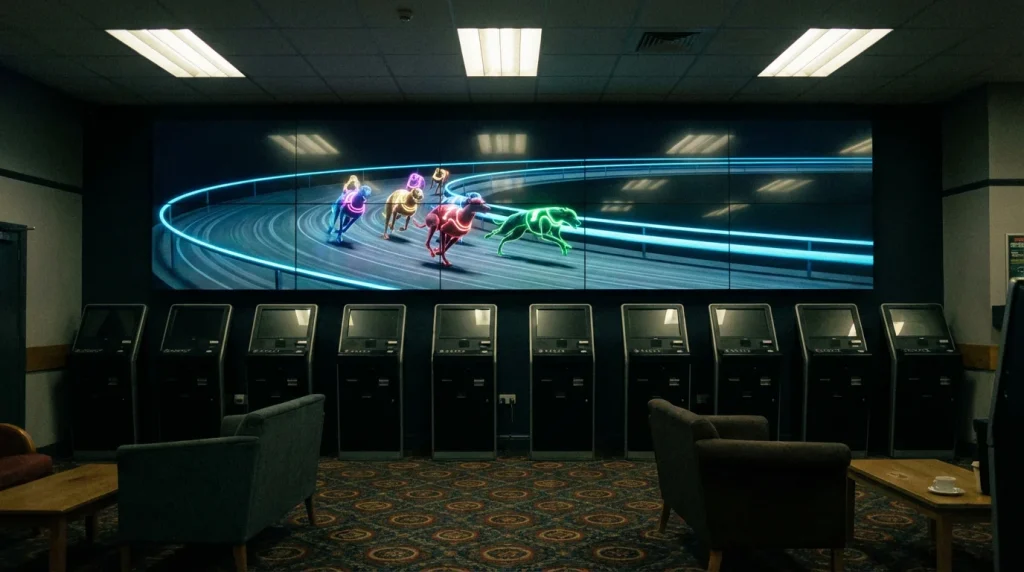
Virtual Racing Looks Like Greyhound Racing — It Isn’t
Virtual greyhound racing is available around the clock on every major UK bookmaker’s platform. The races run every few minutes, the dogs have names and form figures, and the on-screen graphics are polished enough to resemble a real meeting. But the resemblance is superficial. Virtual greyhound racing is a random number generator dressed in a racing jacket. No real dogs run. No real form exists. No skill-based analysis applies. Understanding what virtual racing actually is — and isn’t — prevents bettors from confusing it with the real sport. Find more racing guides at dogracingfastresults.
The product exists because bookmakers need content between live meetings. When there’s no real greyhound racing available — mornings, late nights, gaps between fixtures — virtual racing fills the screen and keeps the betting flowing. It’s a significant revenue generator for operators, and its appeal lies in the instant gratification of a race every three minutes with no waiting, no weather delays, and no non-runners.
For bettors who treat it as what it is — a game of pure chance with a fixed house edge — virtual racing is no worse than any other random betting product. The problems arise when bettors apply real-racing analytical habits to a product where those habits are meaningless.
How Virtual Racing Works
Virtual greyhound races are generated by software. Before each race, a random number generator determines the finishing order. The animation you see on screen — dogs running, overtaking, fading — is a graphical representation of an outcome that was decided before the virtual traps opened. The race is theatre. The result is mathematics.
The RNG is governed by the declared probabilities assigned to each runner. Each virtual dog has a predetermined chance of winning, expressed through the odds. Unlike real racing, where odds estimate probability based on form and market dynamics, virtual racing odds are the probability. A virtual dog priced at 3/1 has exactly a 25% chance of winning (adjusted for the bookmaker’s margin), and that probability is hardcoded into the software.
The software is regulated and tested. In the UK, virtual racing products must be licensed by the Gambling Commission, and the RNG must be independently certified to produce truly random outcomes within the declared probability parameters. This means the product is fair in the sense that the declared odds accurately represent the chance of each outcome — there’s no rigging beyond the published house edge. But “fair” in this context means you’re playing against a known mathematical disadvantage, exactly like a casino game.
Each virtual meeting cycles through a set of races with different fields, distances, and odds structures. Some providers give the virtual dogs names, fictitious form figures, and even simulated race comments. These are cosmetic features designed to make the product feel like real racing. They carry no predictive information whatsoever. The form figure showing that “Virtual Bolt” won its last three races does not mean it’s more likely to win the current race — the RNG treats every race as an independent event.
Odds & RNG Mechanics
The odds in virtual greyhound racing are set by the software provider, not by market dynamics. There’s no flow of money adjusting prices, no on-course bookmakers, and no exchange market. The odds are fixed for each race, and every bettor who places a bet receives those published odds regardless of how much money has been wagered.
The overround on virtual greyhound races is typically higher than on real racing — often between 125% and 140%. This means the house edge is larger, and the long-term cost of playing is greater per pound staked than betting on actual greyhound races. The bookmaker doesn’t need to manage risk on virtual racing the way it does on live sport, because the payout probabilities are known in advance and the law of large numbers guarantees the house margin over sufficient volume.
Because the outcomes are genuinely random, no staking system, pattern recognition, or historical analysis can produce an edge. The gambler’s fallacy — believing that a dog “due” a win based on recent losses — is precisely that: a fallacy. Each virtual race is independent. The RNG has no memory. A virtual dog that has lost eight consecutive races has exactly the same probability of winning the ninth race as its published odds indicate.
Some bettors attempt to find patterns in virtual racing results, tracking which trap numbers or which named dogs win most frequently over a session. Over small samples, random variation will inevitably produce apparent patterns. These are statistical noise, not exploitable trends. Over sufficiently large samples, the results will converge on the published probabilities, confirming the randomness of the product. Any short-term “system” that appears to work on virtual racing is experiencing luck, not demonstrating skill.
The practical implication is stark: every pound wagered on virtual greyhound racing has a negative expected return. There is no analytical edge to find, no form to study, no value to exploit. The house always wins in the long run, and the long run in virtual racing — with races every three minutes — arrives quickly.
Virtual vs Real: Key Differences
The differences between virtual and real greyhound racing are fundamental, not just cosmetic, and bettors should be clear about what each product offers.
In real greyhound racing, skill-based analysis can produce a genuine edge. Form, trap draw, sectional times, trainer patterns, track conditions, and market dynamics all provide information that a knowledgeable bettor can use to make selections with positive expected value. The bookmaker’s overround is a cost, but it can be overcome by consistently identifying value. Profitable greyhound bettors exist because the sport contains exploitable information asymmetries.
In virtual racing, no exploitable information exists. The only variable is the published odds, and those odds include a margin that guarantees the house wins over time. The product is structurally identical to a casino game with variable payouts — a slot machine themed around greyhound racing.
The pace and availability differ too. Real greyhound racing follows a schedule tied to licensed tracks, with meetings on specific evenings and BAGS cards during the day. There are natural breaks, time for analysis, and periods where no racing is available. Virtual racing runs continuously, twenty-four hours a day, with a new race starting every two to three minutes. This relentless availability is designed to maximise engagement and, consequently, turnover. The absence of natural pauses removes the breathing space that real racing provides, making it easier to bet impulsively and harder to step away.
Betting markets are fundamentally different. Real greyhound markets are dynamic — prices move based on money and information, and the savvy bettor can exploit these movements. Virtual markets are static — the price you see is the price you get, determined by algorithm, unmoved by any external input. There’s no “taking the early price” in virtual racing because the price doesn’t change. Also check our live greyhound results.
Pixels and Probability
Virtual greyhound racing is a product, not a sport. Treating it as entertainment with controlled, modest stakes is entirely reasonable — it fills gaps in the racing calendar and provides instant action for punters who enjoy the format. Treating it as a serious betting medium, applying analytical techniques borrowed from real racing, or spending time studying the fictional form of computer-generated dogs is a misallocation of effort. The pixels on the screen follow a script written by a random number generator. The only number that matters is the house edge, and it’s working against you from the first bet to the last.
