
How Greyhound Racing Odds Work: Fractional & Decimal
 Available in US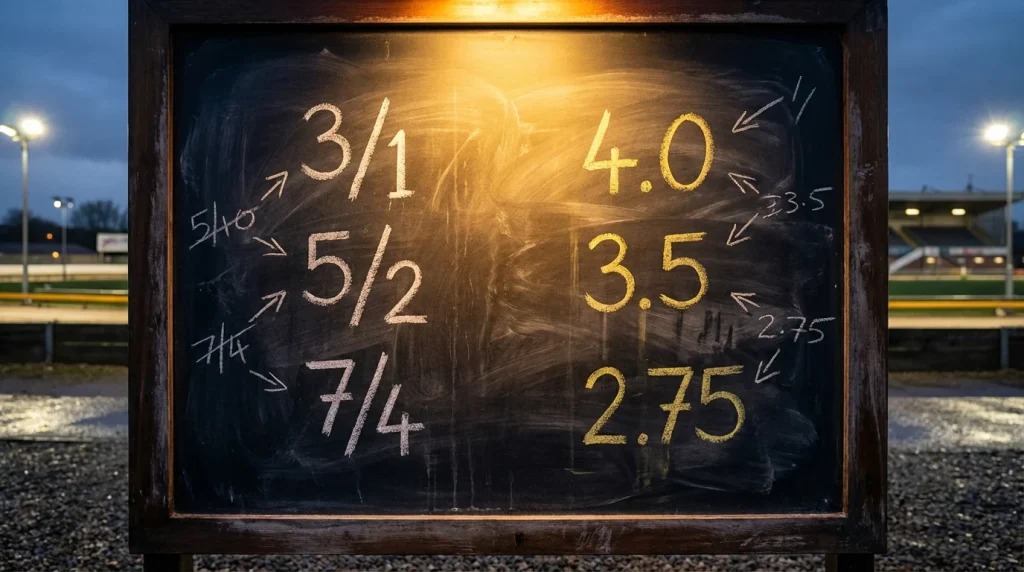
Odds Are the Market’s Opinion — Not the Truth
Odds tell you what the market thinks. Not what will happen. Every price you see on a greyhound racecard — whether it’s 3/1, 7/2, or 4.50 — is a translation of probability into money. The shorter the odds, the more likely the market considers that dog to win. The longer the odds, the less likely. But probability expressed by a bookmaker isn’t pure mathematics. It’s probability with a margin built in, shaped by money flows, form data, and the bookmaker’s own risk management. Find more odds guides at dogracingfastresults.
Understanding how odds work is the mechanical foundation of greyhound betting. You can’t evaluate whether a price represents value without knowing what the price actually implies. You can’t compare bookmakers without understanding that 3/1 at one site and 7/2 at another represent different expected returns on the same bet. And you can’t make sense of why odds move — shortening or drifting in the minutes before a race — without understanding what drives those movements.
This isn’t abstract theory. It’s the everyday arithmetic that separates bettors who know what they’re doing from those who pick a dog and accept whatever price they’re given.
Fractional vs Decimal Odds
3/1 and 4.0 are the same thing. UK punters use both formats, often without fully appreciating how they relate to each other, and increasingly the decimal format is becoming the default on online platforms.
Fractional odds — the traditional UK format — express profit relative to stake. Odds of 3/1 mean you win £3 for every £1 you stake, plus you get your stake back. So a £10 bet at 3/1 returns £40 total: £30 profit plus your £10 stake. Odds of 7/2 mean you win £7 for every £2 staked — a £10 bet returns £45 total.
Decimal odds — the format standard across Europe and increasingly common on UK betting sites — express the total return per unit staked, including the stake. Odds of 4.0 mean your total return is £4 for every £1 staked, which includes £3 profit and your £1 back. This is identical to 3/1 in fractional terms. Odds of 4.50 equal 7/2 fractional.
The conversion is straightforward. To convert fractional to decimal, divide the first number by the second and add 1. So 3/1 becomes (3 ÷ 1) + 1 = 4.0. And 7/2 becomes (7 ÷ 2) + 1 = 4.5. To convert decimal to fractional, subtract 1 and express as a fraction: 4.0 becomes 3/1, and 2.5 becomes 3/2.
Some common fractional odds and their decimal equivalents that appear constantly in greyhound racing:
| Fractional | Decimal | £10 Stake Returns |
|---|---|---|
| 1/2 | 1.50 | £15.00 |
| Evens (1/1) | 2.00 | £20.00 |
| 2/1 | 3.00 | £30.00 |
| 3/1 | 4.00 | £40.00 |
| 5/1 | 6.00 | £60.00 |
| 7/1 | 8.00 | £80.00 |
| 10/1 | 11.00 | £110.00 |
Decimal odds are mathematically cleaner for calculations, which is why professional bettors and exchange users tend to prefer them. Working out returns on multiples, calculating implied probabilities, and comparing prices across bookmakers is simpler in decimal. Fractional odds carry more cultural weight in the UK and remain the standard at on-course bookmakers and in betting shops. Use whichever format you’re comfortable with, but be fluent in both — greyhound markets will present you with each depending on the platform.
Implied Probability & Overround
Add up the probabilities and you get more than 100%. That’s the bookmaker’s cut, and understanding it is the single most important concept in odds literacy.
Every set of odds can be converted into an implied probability. Odds of 3/1 (decimal 4.0) imply a 25% chance of winning. The formula is simple: 1 divided by the decimal odds. So 1 ÷ 4.0 = 0.25, or 25%. Odds of 2/1 (3.0 decimal) imply a 33.3% chance. Odds of 1/2 (1.50 decimal) imply a 66.7% chance.
In a fair market with no bookmaker margin, the implied probabilities of all runners in a race would sum to exactly 100%. In reality, they always sum to more than 100%. In UK greyhound racing, the total overround on a typical six-runner race is around 120-130%, meaning the bookmaker has built in a margin of 20-30% across the field. This is considerably higher than the overround on a major horse race, which might be 110-115%, and it reflects the lower liquidity and higher risk the bookmaker perceives in greyhound markets.
Here’s what that looks like in practice. Consider a six-dog race with the following prices:
| Trap | Odds | Implied Probability |
|---|---|---|
| 1 | 5/2 (3.50) | 28.6% |
| 2 | 3/1 (4.00) | 25.0% |
| 3 | 7/2 (4.50) | 22.2% |
| 4 | 5/1 (6.00) | 16.7% |
| 5 | 6/1 (7.00) | 14.3% |
| 6 | 8/1 (9.00) | 11.1% |
The implied probabilities sum to 117.9%. The extra 17.9% is the bookmaker’s theoretical margin — the overround. In effect, you’re paying a 17.9% premium for the privilege of betting on this race. The higher the overround, the worse the deal for the bettor.
Overround matters because it directly affects your long-term returns. If you consistently bet at prices that reflect a 125% book, you need to be right significantly more often than probability alone suggests just to break even. The overround is the house edge in greyhound betting, and it’s baked into every price you see. Reducing the effective overround you face — by shopping for the best price across multiple bookmakers, or by using the exchange where the margin is lower — is one of the most reliable ways to improve long-term results.
How Odds Move in Greyhound Markets
Money talks. When a dog drifts from 3/1 to 5/1, there’s a reason. Greyhound odds are not static. They move between the time the market opens and the moment the traps open, driven by the flow of money into the market and by information — real or perceived — reaching the betting public.
A dog whose odds shorten — moving from, say, 5/1 to 3/1 — is attracting money. This could mean informed bettors have identified it as a strong contender, that a tipster has recommended it, or that a significant amount of money has been placed on it at one bookmaker and the rest of the market has adjusted in response. Shortening odds don’t guarantee the dog will win, but they indicate that the market is revising its probability estimate upwards.
A dog whose odds drift — moving from 3/1 to 5/1 — is losing support. Money is going elsewhere. This might reflect negative information (a poor trial, a trainer concern, an unfavourable draw), or it might simply mean that another dog in the same race has attracted disproportionate support, causing the rest of the field to drift by default. In greyhound racing, where the fields are small and the total betting pool is limited, money on one dog moves the others more visibly than in horse racing.
Monitoring market movements in the thirty minutes before a greyhound race can provide useful intelligence. A sudden, sharp contraction in one dog’s price might indicate a gamble — money arriving from people who believe they have an information edge. Whether that information is accurate is another question, but significant money usually has a reason behind it, even if that reason is sometimes wrong.
Exchange markets on Betfair provide an additional layer of price discovery. Because the exchange shows both the price available and the amount of money available at each price, you can see depth and direction of the market. A dog that’s 4.0 on the exchange with £500 waiting to be matched at that price is in a different position from a dog that’s 4.0 with only £20 available. The former suggests genuine market confidence; the latter might just be a single punter’s opinion.
For bettors, the key discipline is separating signal from noise. Not every odds movement is meaningful. Prices fluctuate constantly in response to small bets, algorithmic adjustments by bookmakers, and the general churn of a live market. The movements that matter are the large, sustained ones — a dog that shortens from 6/1 to 3/1 and stays there has been the subject of real money. A dog that bounces between 7/2 and 4/1 in the last ten minutes is just experiencing normal market volatility.
Reading the Market, Not Just the Numbers
Odds are information. Treat them that way. Every greyhound race is a small market with six competing assets, each priced according to the collective assessment of every bettor, bookmaker, and algorithm participating. The prices carry information about form, draw, conditions, and insider sentiment — filtered through the lens of money. Also read our starting price guide.
The punters who develop an intuition for odds are the ones who watch markets repeatedly, note when prices deviate from what form suggests, and learn which patterns precede winning results. Over time, the odds themselves become a form of data — not a substitute for racecard analysis, but a complement to it. When your form assessment says a dog should be 4/1 and the market says 6/1, that discrepancy is either an opportunity or a warning. Deciding which it is, on a race-by-race basis, is the ongoing puzzle that makes greyhound betting both challenging and rewarding.
